Bharat Semi has raised $24 million in an all-equity seed round to develop AI-enabled image sensors, the New Delhi startup said on November 15. The round was led by Info Edge Group, South Park Commons and Indus Bridge Ventures, with Valour Capital, Micromax, Gaingels and individual investors taking part.
Bharat Semi is building programmable image sensors that combine image capture, processing and AI capabilities on a single chip. The design removes the need to send visual data to separate processors, and co-founder Vrinda Kapoor said it could cut system costs by at least 70 percent compared with a conventional setup that uses a separate image sensor, image signal processor and system-on-chip.
The startup is still pre-revenue, but it says it has already secured design wins with US defense technology company General Atomics and India’s Kaynes Semicon. Its image sensors remain under development, with first commercial production targeted for 2027.
One chip instead of three
A camera that runs AI today usually needs three parts, a sensor, a signal processor and a main chip. Bharat Semi wants to fold all three into one programmable sensor, so inference happens at the point of capture instead of in the cloud or on a separate processor.
The company says the approach can cut the movement of data between components by up to 99 percent. That matters for devices that must react in the moment, from drones and robots to smart home products and surveillance cameras.
“Our aim here is to move from sensors to sense-making solutions.”
Vrinda Kapoor, Co-founder of Bharat Semi
Bharat Semi is targeting smart homes, industrial automation, surveillance and aerospace. It is starting with consumer electronics and surveillance, two markets where cost, power and latency decide which products win. Its long-term goal is a single versatile sensor architecture that serves industries from robotics to automotive.
Early customers before revenue
The company’s first-generation sensors are already in prototyping. Second-generation sensors with more advanced AI features are expected to reach the prototype stage by mid-2027, and Kapoor said the company plans to get those newer sensors into customers’ hands by the end of 2027.
Bharat Semi has about 75 employees across India and the US, including 10 to 12 in its American operations in Santa Clara. It plans to raise its US headcount to around 20 by mid-2027 and has also begun hiring engineers in Europe.
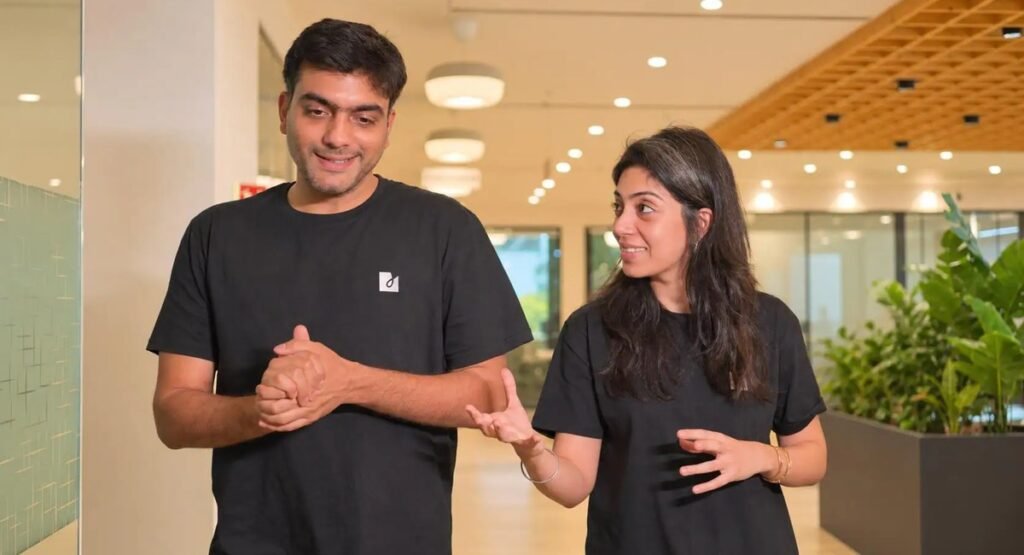
Kapoor co-founded the company in late 2021 with Vinayak Dalmia, its managing director. Dalmia previously worked at McKinsey and in private equity, and holds an MPhil from the University of Cambridge. Kapoor previously worked on India’s semiconductor initiatives with NITI Aayog’s Frontier Technology Hub. The chief technology officer is Boyd Fowler, who previously held the same role at image-sensor maker OmniVision.
Where the money goes
The funding will expand the engineering team, complete product development and bring the sensors to market. It will also advance the company’s go-to-market work with global customers and grow its engineering teams in the US.
The round also included angel investors Mukul Agarwal and Karthik Sundar Iyer, and Bharat Semi has not disclosed a valuation.
A separate plan for a chip plant
In 2024, Bharat Semi announced plans for a semiconductor fabrication project in India involving a technology partnership with the US Space Force. That initiative remains in development, and the company is working to identify domestic partners that would build and operate the facility.
The project is separate from the image-sensor business. Bharat Semi plans to remain fabless, outsourcing chip manufacturing while focusing on semiconductor design and software, and the new funding will not be used to finance the proposed plant.
India has committed billions of dollars to build a domestic semiconductor industry, hoping to become an alternative manufacturing hub as US companies look to diversify supply chains beyond China.
Why investors are backing the bet
The pitch is tied to Physical AI, the shift of AI from screens into machines that see and act in the real world. Morgan Stanley expects around a billion humanoid robots to be in use by 2050, and a McKinsey study found that no widely adopted intelligent sensor suite exists today.
Vibhore Sharma, founding partner of Redstart, the deeptech arm of Info Edge, said the startup is “tackling a significant limitation in Physical AI at its origin, within the silicon itself.” Prateek Mehta, general partner at South Park Commons, said Bharat Semi is “taking on the challenge of how Physical AI actually gets built.”
“This data may never be seen by humans, but it will drive AI at the edge.”
Vinayak Dalmia, Co-founder of Bharat Semi
You can follow more AI funding rounds on our funding tracker.