Moonshot AI has introduced Kimi K3.1 Pro, the first model in its new K3.1 series and the company’s most capable 3-trillion-parameter-class open-weight model to date. It carries a 1-million-token context window and targets coding, 3D creation, financial research and agentic work.
Kimi K3.1 Pro and a faster K3.1 Pro Highspeed variant are available now on Kimi.ai, the Kimi mobile apps, Kimi Work, Kimi Code and the Kimi API. Moonshot says the full model weights will be released by November 4.
The model is a post-trained version of Kimi K3, built with substantially more post-training compute. Moonshot says it optimized every layer of its stack for large-scale joint reinforcement learning across hundreds of downstream domains, which produced consistent gains in every domain it tested.
A step closer to the proprietary models
On Terminal-Bench 4.0, which tests coding agents on realistic terminal tasks, K3.1 Pro scored 65.7 percent. That puts it ahead of GPT-6 Astra at 58.2 percent and just behind Claude Opus 5.5 at 66.4 percent, according to Moonshot’s own evaluation.
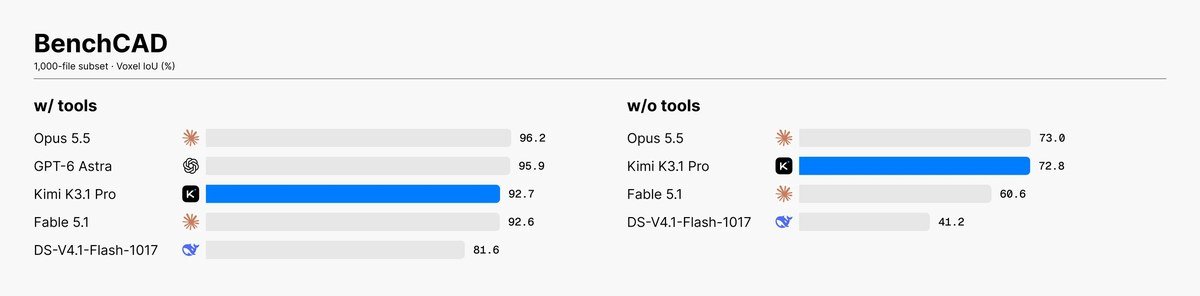
The model also looks strong at 3D work. On BenchCAD, which tests 3D reconstruction through CAD code generation, it scored 92.7 percent with tools, approaching the scores of Claude Opus 5.5 and GPT-6 Astra. Its new 3D Make feature is now live on kimi.ai and the Kimi app, letting users preview and edit 3D models online.
For finance work, K3.1 Pro reached 64.4 on OfficeQA Pro v2, which tests analysis over real financial documents. Moonshot reports its claim-level hallucination rate fell from 23.4 percent on K3 to 8.3 percent on its hardest internal factual-accuracy test.
Open weights with the hacking skills removed
Moonshot is deliberately curbing the model’s cyber-offensive abilities before the weights go public. It identified and removed cyber-related data from both training stages, while keeping the general-purpose coding tasks that make the model useful.
The company measured the effect on xdev-bench-hard, an internal evaluation that reproduces recently disclosed vulnerabilities in software such as the Linux kernel and Node.js. The final model solved 81.0 percent of the problems, down from 90.5 percent for a version trained without the controls.
“We aim not to release open weights that would extend the absolute frontier of cyber capability,” the company said in its announcement.
The move lands as governments grow more worried about AI speeding up cyberattacks. China proposed export controls last week that would ban exports of AI-driven malware-generation technology and restrict AI-assisted vulnerability-discovery tools. The draft measures remain open for public comment.
Moonshot argues open weights can still improve security, because more teams can audit the code they maintain, including legacy systems that rarely get dedicated security reviews.
Why it matters
K3.1 Pro sharpens the race between open and proprietary models. A 3-trillion-parameter open-weight model that nearly matches the strongest closed systems on coding tasks raises the pressure on Western labs to defend their lead.
The cybersecurity angle sets this launch apart. Few labs have published this much detail about dialing down a capability before release. If others follow, capability reviews could become a normal part of open-weight releases.
The weights land by November 4. Developers will get to test whether the scores hold outside Moonshot’s own benchmarks, and whether an open model with deliberately limited hacking skills still proves useful enough to win them over.