Thinking Machines Lab has released Inkling 2 Mini, a model small enough to run on a laptop yet strong enough to lead open weights models of its size on coding tests. The lab announced the model on November 20, 2026, and published its weights the same day.
A model that reuses its own layers
Inkling 2 Mini is a looped transformer. It has 24 layers, and its middle 12 layers run three times for every token the model generates. The design gives the model 48 layer visits from 24 stored layers, so it can reason longer without adding new weights.
The model has 26.4 billion total parameters, with 3.4 billion active for each token. Once looping is counted, it makes 5.4 billion weight activations per token. It also takes text and image input and supports a context window of one million tokens.
Built for a laptop, not a data centre
Most of the model weights were trained and shipped in NVFP4, a compact number format, with the last four layers in MXFP8. The full model takes about 20 gigabytes of memory, which lets it run on consumer laptops and desktop AI computers.
To show this off, the lab ran the model offline on a MacBook Pro during a flight. In a few minutes it built a playable flight simulator, with no internet connection and no cloud server involved.
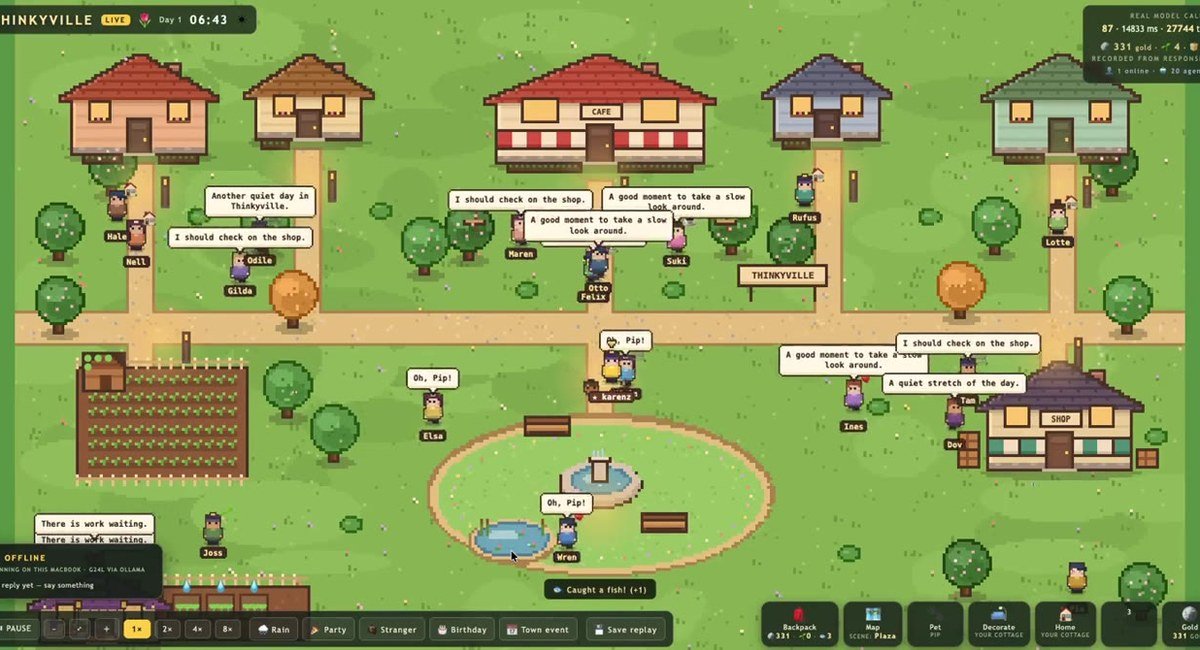
The lab also ran a small pixel village called Thinkyville on a single offline MacBook. The same model powered all 20 villagers, who plan their days, gossip and answer notes left on their doors.
Strong on coding, honest about the gaps
In the lab’s own tests, Inkling 2 Mini leads every open weights model under 100 billion total parameters on DeepSWE v1.1, scoring 48.2 percent. It scored 79.2 percent on SWE-bench Verified and 77.9 percent on the hard set of SWE-bench Pro v2.
Independent tester Artificial Analysis gives the model 20.1 on its Intelligence Index, level with Alibaba’s Qwen3.8-27B. It also found the model costs about $0.59 per task against $3.53 for Qwen, and finishes in nine minutes against 38.
The lab is open about the limits too. The model trails Qwen3.8-27B on multi-turn chat and on instructions with many constraints, and it does not store more facts than other models of its size. Its strength is reasoning and tool use, not recall.
Open weights, ready to download
Inkling 2 Mini is released under the Apache 2.0 license, and its weights are available on Hugging Face. The lab offers inference and fine tuning through its Tinker platform, and the model also runs through Ollama, llama.cpp, MLX, SGLang and vLLM.
Alongside the main model, the lab released a research variant that accepts a variable number of loop passes. It lets researchers study how looping changes what a model can do and how easy it stays to oversee.
Thinking Machines Lab was founded in 2025 by Mira Murati, OpenAI’s former chief technology officer. Inkling 2 Mini is its smallest model yet, following the much larger Inkling 2 Small earlier in November.