Cursor, Codex, Claude Code, Replit and other AI coding tools are changing who can build software and how quickly.
A developer, startup team, solo founder or independent builder can now turn an idea into working code in hours. But the apparent finish line is often only the halfway point.
The code may work locally; getting it online, secure, observable and dependable for real users still demands a very different set of skills. Kuberns is focused on closing that gap.
The market gap: AI accelerated building, not going live
The software creation stack has moved forward at remarkable speed. AI assistants can scaffold interfaces, write APIs, connect databases, debug errors and generate substantial parts of a product. That has given small teams leverage that once required a much larger engineering organisation.
Yet deployment still confronts the builder with runtime versions, build and start commands, containers, networking, environment variables, databases, domains, SSL, scaling, monitoring and recovery.
That mismatch creates a new last-mile problem. The people now empowered to create software are not always infrastructure specialists and they should not need to become one simply to test an idea with real users. Even experienced developers lose momentum when a fast coding session turns into hours of reading cloud documentation, writing configuration files and tracing deployment failures across disconnected tools.
The moment the opportunity became clear
The Kuberns saw that developers were not asking for more cloud controls. They wanted their applications to go live without having to translate every requirement into infrastructure decisions.
That led to the central idea behind Kuberns: instead of asking the developer to configure the platform first, the platform should understand the application first.
The problem has also been recognised by one of AI’s most influential builders. In a video shared by Andrej Karpathy, he explains that building the code can take about a day while configuring the surrounding services and getting it live can take about a week.
In a X post, Karpathy lists the many pieces that can sit around even a relatively small application from domains, hosting and databases to authentication, payments, email and monitoring.
The reality of building web apps in 2025 is that it’s a bit like assembling IKEA furniture. There’s no “full-stack” product with batteries included, you have to piece together and configure many individual services:
– frontend / backend (e.g. React, Next.js, APIs)
– hosting…— Andrej Karpathy (@karpathy) March 27, 2025
His comments are not an endorsement of Kuberns; they capture the wider market problem that Kuberns is trying to solve.
A deployment platform designed around an outcome
Kuberns is an agentic AI platform for deployment, built for developers globally. Its objective is not to give users another collection of cloud controls. It is to help them move a project from a GitHub repository to a running production environment with less manual infrastructure work.
Because conventional automation systems start from different assumptions. Traditional automation follows a predefined sequence once a person has supplied the correct inputs. An agentic workflow starts with an intended outcome, evaluates the available context, and determines the work required to reach it. In Kuberns, that context is the application repository and the outcome is a production deployment.
How the agentic deployment flow works in Kuberns
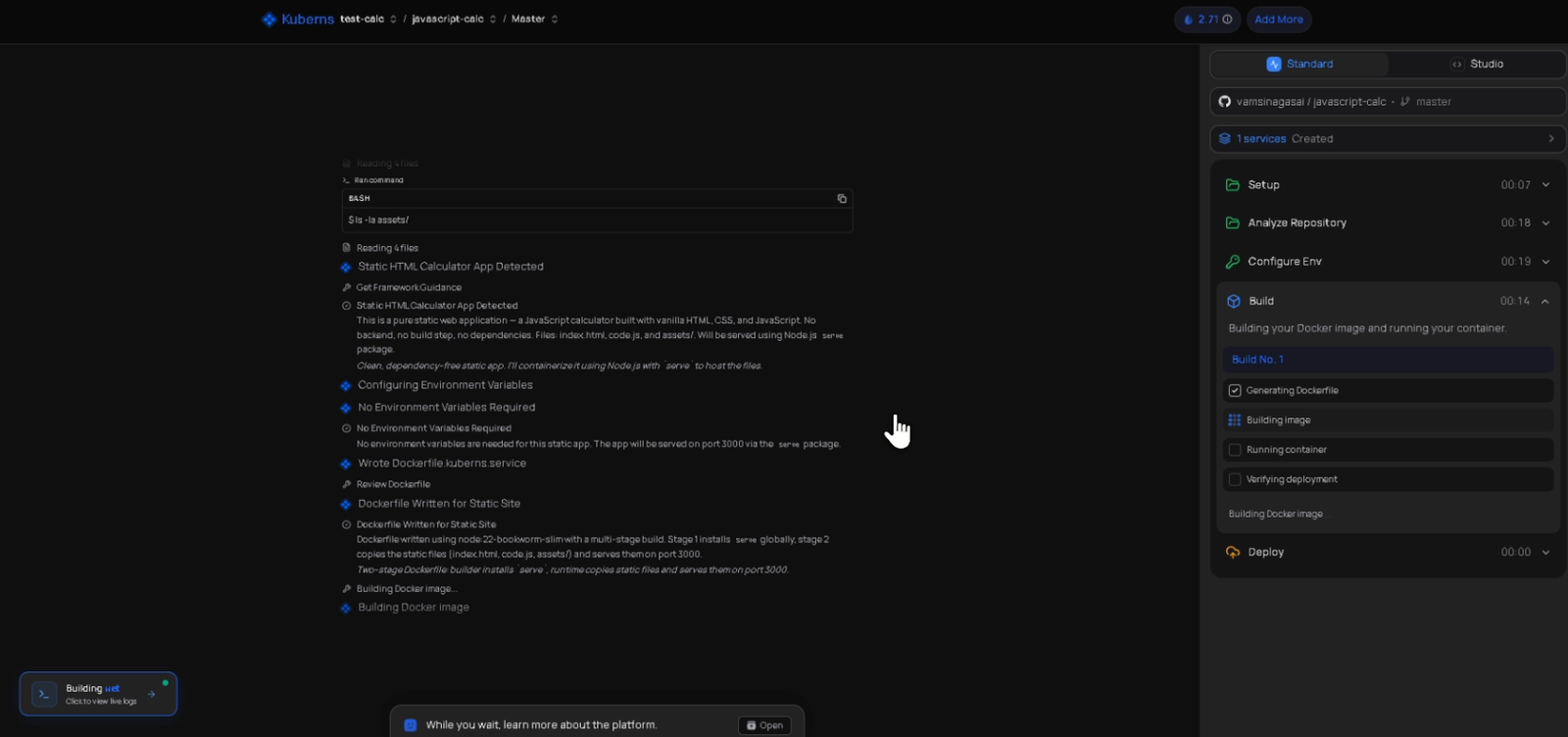
- Connect: The developer connects the GitHub repository containing the application and Click Deploy.
- Analyse: Kuberns agentic AI examines the project structure and detects signals such as the language, framework, runtime, dependencies, build command, start command, and expected port.
- Plan: The agentic workflow determines the deployment path and the infrastructure configuration the application requires.
- Configure: The platform prepares the build and runtime environment and coordinates settings such as compute, networking, HTTPS, environment variables, domains, and databases where relevant.
- Deploy: Kuberns builds the application, provisions the required infrastructure on cloud, and returns a live endpoint through one connected workflow.
- Operate: Subsequent deployments, logs, monitoring, scaling, domains, and other application operations remain accessible from the same dashboard.
The goal is simple: let builders begin with their application instead of beginning with a collection of cloud resources. AI is not presented as the destination; it is the mechanism used to reduce manual planning, configuration and context switching.
Why agentic AI is more than just a label
Agentic AI is increasingly used to describe software that can reason across a multi-step task instead of producing a single response.
Deployment is a strong test of that idea because success depends on coordinated decisions. Detecting that a repository contains Python is not enough; the platform must also understand the framework, dependency file, start process, port behaviour, environment requirements, and infrastructure needed to keep the application available.
Kuberns applies the agentic model to this chain of work.
The aim is not to make AI itself the user’s destination. The user’s destination is a reliable application running in production. AI is the mechanism used to reduce the planning, configuration, and context switching between source code and cloud operations.
This is particularly relevant as AI-generated applications become common. Coding agents expand the population of builders, but deployment products have largely retained interfaces designed for people who already understand infrastructure.
Kuberns’ bet is that the deployment layer now needs its own agentic shift: a system that can inspect the repository, reason about what the application requires, prepare the environment and coordinate the path to production while keeping the developer informed and in control.
Why this matters now
AI coding agents are expanding the number of people who can create useful software. They are also allowing experienced engineers to attempt more products with smaller teams.
If deployment continues to require a separate infrastructure learning curve, many of those projects will remain demos rather than becoming products used by customers.
Platforms such as Heroku, Render, Railway, Fly.io, Netlify and Vercel have each made deployment easier in important ways.
Kuberns’ thesis is not that deployment platforms are absent. It is that the next generation of deployment can be more context-aware and outcome-oriented particularly for builders whose code was created with the help of AI.
The platform is intended to support frontend applications, backend APIs, full-stack projects, workers, and databases through a connected experience.
Built in India, aimed at developers everywhere
India is globally recognised for software engineering talent and technology services, but many of the products Indian developers use to build, deploy, and operate software were created elsewhere.
More than 7,000 developers globally have onboarded on Kuberns. For the company, that early adoption is an indication that deployment complexity is not limited to one geography or one type of developer.
Teams everywhere are looking for a shorter path between finished code and a dependable production environment.
India is already known globally for its engineering talent and technology services. Kuberns represents another ambition: building a core developer product in India that can compete in an established global cloud category.
A new way for developers to ship
For developers, the promise of Kuberns is not simply a faster deployment button. It is the ability to stay focused on the application, the experience, features and problems that matter to users while an intelligent platform handles more of the infrastructure work that traditionally interrupts the building process.
As AI coding tools help more people turn ideas into working software, Kuberns aims to make the next step just as accessible: moving that software from a repository into a dependable production environment. If it succeeds, developers will spend less time configuring how an application runs and more time improving what it does. That is the change Kuberns wants to bring from India to builders everywhere.