Voice AI has quietly become one of the most commercially serious use cases in all of artificial intelligence. Not chatbots on websites, but actual phone calls. We are talking about AI agents that answer support lines, qualify sales leads, book appointments, and chase unpaid invoices, in voices most callers cannot distinguish from humans.
The numbers explain why every contact center leader is paying attention. Gartner forecasts that conversational AI will reduce contact-center labor costs by $80 billion in 2026. The voice AI agents market itself was valued at $2.4 billion in 2024 and is projected to reach $47.5 billion by 2034, growing at 34.8% a year, according to Market.us.
To help you find the best AI voice agent a market that added dozens of vendors in the last eighteen months, our AI experts tested the documentation, pricing, and real buyer feedback for the leading platforms and narrowed them to the ten that matter for support and sales teams.
Every tool below was verified as active and shipping in September 2026.
AI Voice Agents At A Glance
Short on time? This is the one-table summary. Each platform below serves a different buyer, so start with the one that matches your situation, then read its full breakdown.
| Platform | Best For |
|---|---|
| Retell AI | Developers who want to stress-test agents with simulated calls before spending on telephony |
| Vapi | Engineering teams that want full control over every layer of the voice stack |
| Bland AI | Regulated industries like healthcare, finance, and insurance |
| Synthflow AI | Business teams that want a no-code builder with enterprise backing |
| ElevenLabs | Premium customer experiences where voice quality is the brand |
| Sierra | Enterprises that prefer paying per resolved conversation over per-minute billing |
| Replicant | Contact centers replacing IVR and tier-1 human queues inside existing infrastructure |
| Kore.ai | Companies that want voice, chat, and employee agents on one platform |
| Yellow.ai | Multinationals needing voice plus WhatsApp across APAC and the Middle East |
| Cognigy | Low-code voice design for NiCE shops and European enterprise teams |
1. Retell AI
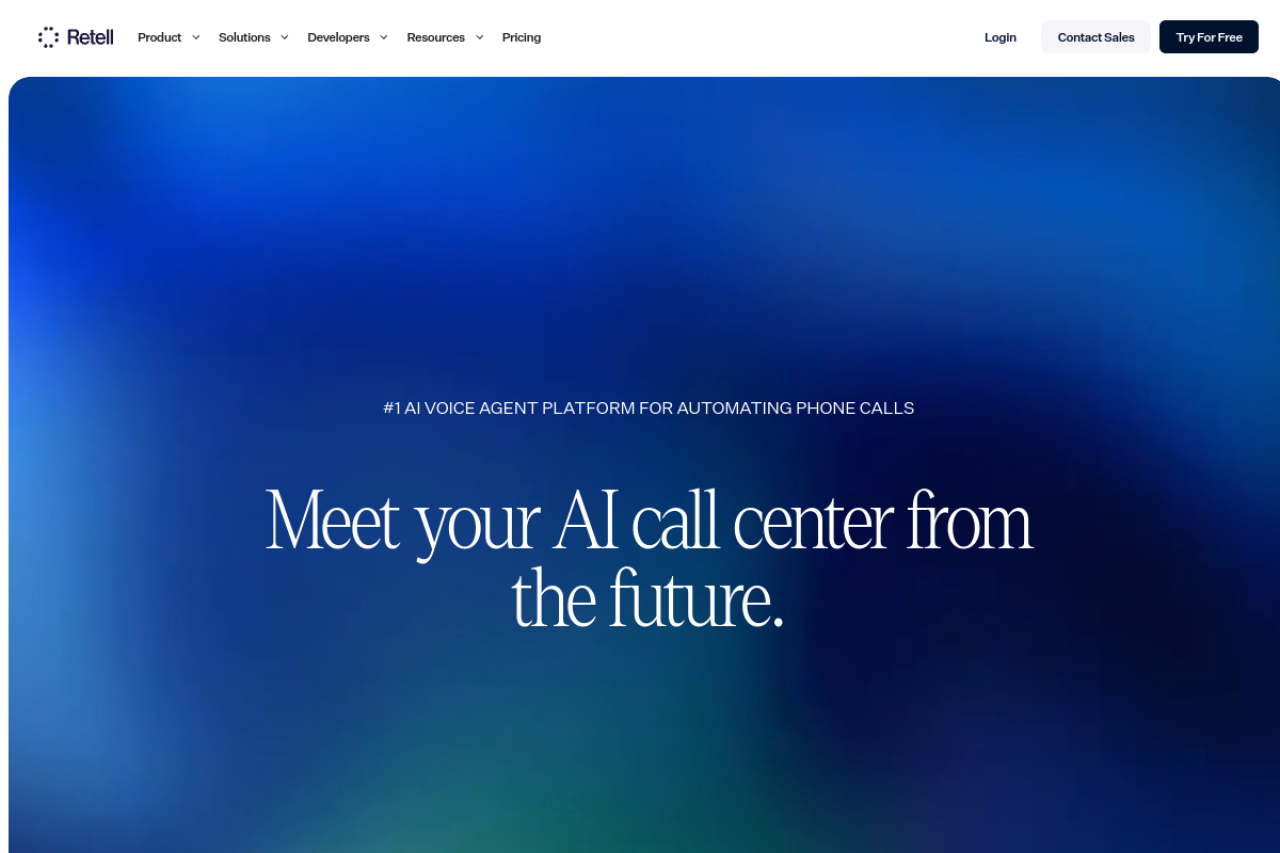
Retell AI is a developer platform for building production-grade voice agents for inbound and outbound calls. Its standout capability is simulation testing. You can run thousands of synthetic calls against your agent before it ever touches a real phone line, which is the closest thing this market has to a staging environment for voice.
Key features
- Inbound and outbound calling with a visual flow builder plus API-first deployment
- Simulation testing with thousands of synthetic calls before going live
- Call analytics, recording, transcription, and post-call summaries
- Bring your own LLM and voice providers, or use Retell’s defaults
- Warm transfers to human agents with full conversation context
Pricing
Pay-as-you-go per-minute pricing, reported at roughly $0.07 to $0.31 per minute depending on voice, LLM, and telephony choices. New accounts reportedly receive $10 in credits. Because pricing is modular, model your full stack before committing.
Pros
- Fastest path from prototype to production in this group, with simulation testing that is genuinely unusual at this price point
- Swap STT, LLM, and TTS providers instead of accepting vendor lock-in
- Reported 4.8/5 on G2 across roughly 2,600 reviews, suggesting broad developer satisfaction
Cons
- Modular pricing makes the true production cost hard to predict from the headline rate
- Less established enterprise compliance tooling than the contact-center incumbents
TAL’s Take
If your team can write code, start here. The simulation layer alone justifies the evaluation. Most voice AI failures happen on weird edge-case calls, and Retell lets you find them for free instead of discovering them on a customer’s dime. Just budget carefully, because the modular meter runs on four separate faucets. Visit Retell AI
2. Vapi
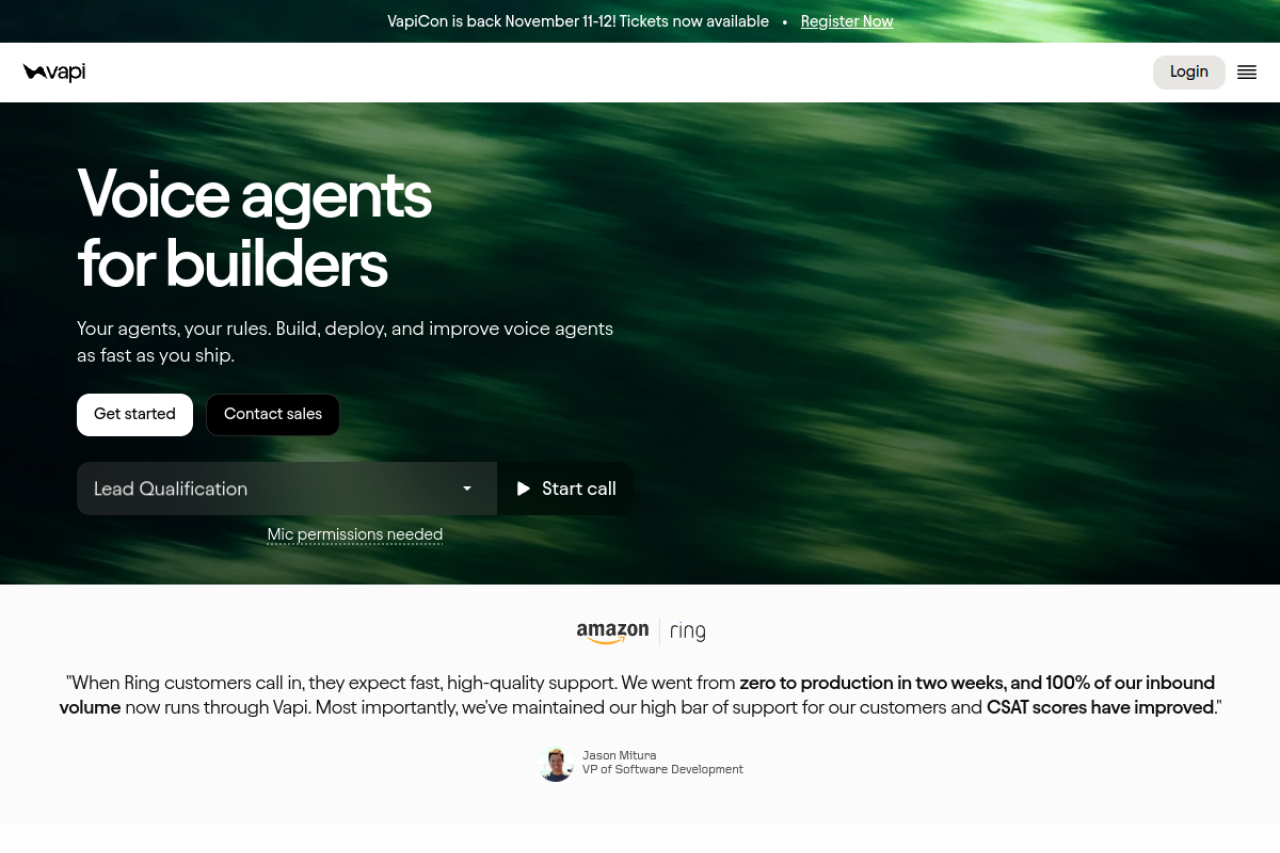
Vapi is the most composable voice AI cloud in this lineup. It is a developer-first platform where engineering teams deploy voice agents across phone, web, and mobile while choosing their own speech-to-text, language model, and text-to-speech providers at every layer. Think of it as infrastructure for voice agents rather than a finished product.
Key features
- Assistants for single agents and Squads for multi-assistant call routing
- Bring your own STT, LLM, and TTS providers, or use Vapi defaults
- SIP trunking to connect existing phone infrastructure
- Function calling and webhooks for live CRM, calendar, and database actions
- Server and web SDKs plus a hosted MCP server for agent management
Pricing
$0.05 per call minute platform fee, plus separate STT, LLM, TTS, and carrier costs. Third-party comparisons put a typical all-in cost around $0.082 to $0.129 per minute. Enterprise plans are sales-led with fixed fees on committed volume.
Pros
- The most modular stack of the ten. Swap nearly every layer of the voice pipeline
- Strong developer ecosystem, documentation, and integrations
- Reported $50M Series B and compliance certifications support regulated deployments
Cons
- Multi-provider billing makes true per-minute cost harder to forecast than bundled rivals
- The visual Workflows product was retired in August 2026, so non-technical buyers get less no-code surface
TAL’s Take
Vapi is the pick when your engineers have opinions about which models should handle which layer. Nobody else lets you compose the stack this freely. The trade-off is operational. You are now the integrator, so bring a team that is comfortable owning that. Non-technical teams should look at Synthflow or Bland instead. Visit Vapi
3. Bland AI
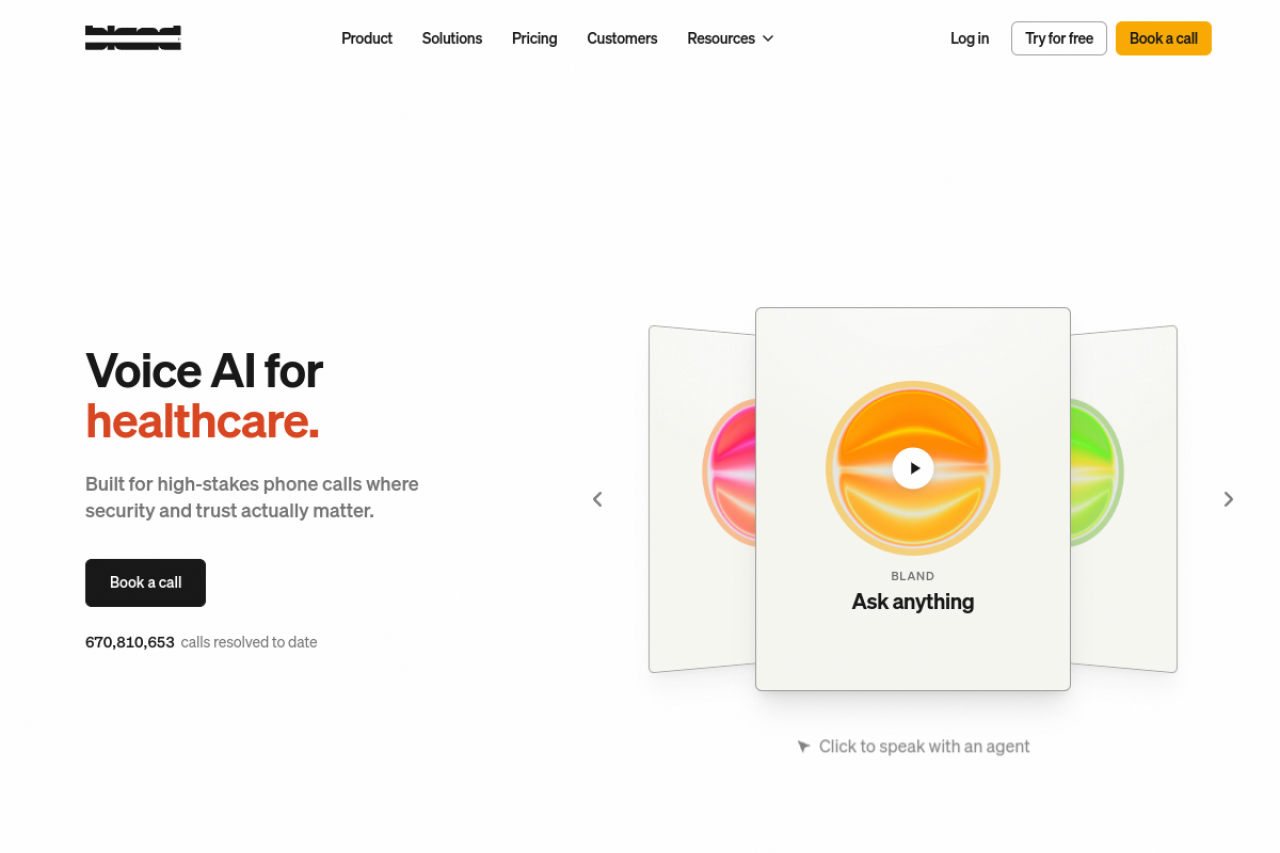
Bland AI runs its voice infrastructure end to end instead of stitching together third-party providers, and it has turned that into its core pitch. Customer call data never passes through someone else’s AI stack. Combined with HIPAA, PCI DSS, and SOC 2 compliance, that makes it the default shortlist candidate for healthcare, finance, and insurance.
Key features
- Inbound and outbound AI calling with a visual Pathways conversation builder
- Custom in-house voice models with cloning from a short audio clip
- Claimed 400ms latency with 40+ languages and mid-call language switching
- Omnichannel deployment across voice, SMS, iMessage, and web chat with shared memory
- Private-cloud and on-prem options for strict data residency needs
Pricing
Start plan at $0 platform fee plus $0.14/min for connected calls; Build at $299/month plus $0.12/min; Scale at $499/month plus $0.11/min; Enterprise is custom. The bundled per-minute rate covers AI, transcription, and voice in one number.
Pros
- One bundled per-minute rate is far easier to budget than modular stacks
- Infrastructure ownership is a real differentiator where data residency matters more than shaving cents per minute
- Compliance posture is stronger out of the box than most developer platforms
Cons
- Complex builds still need engineering; the visual builder has limits for sophisticated logic
- Smaller third-party review footprint, so buyer consensus is thinner
TAL’s Take
Bland wins the regulated-industry buyer almost by default. If your legal team asks “where does call audio go?” you want the vendor that owns the whole pipeline to answer. For everyone else, compare its bundled $0.11 to $0.14 per minute against Vapi or Retell all-in costs at your expected volume before deciding. Visit Bland AI
4. Synthflow AI
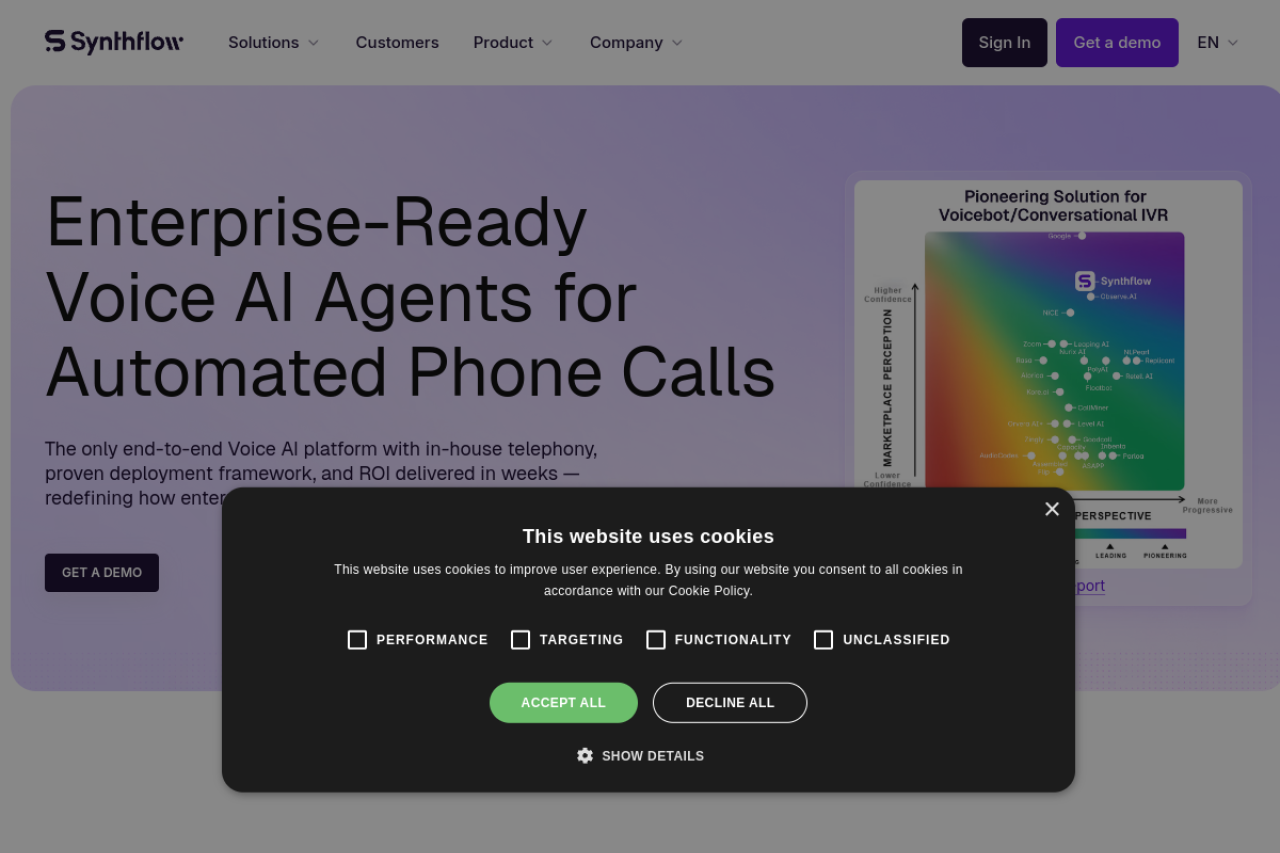
Synthflow is the most approachable builder in this group. It is a genuine no-code platform for designing, testing, and deploying human-like phone agents, running on its own global telephony infrastructure. One important change to know. In late 2026 the company retired its self-serve plans and moved to enterprise-only contracts, so the affordable on-ramp that built its reputation is gone.
Key features
- Visual agent designer for building call flows without writing code
- Owned global telephony infrastructure with claimed sub-100ms latency and 99.9% uptime
- BELL framework with OpenAI. A structured build, evaluate, launch, and learn loop for production voice AI
- Inbound and outbound calling with CRM integrations, call transfer, and appointment booking
- SOC 2, HIPAA, and GDPR compliant with 50+ language support
Pricing
Enterprise quote-only, reported to start around $30,000/year with no free trial. Older pages showing $29 to $1,250 self-serve tiers are outdated. Confirm current terms directly with the vendor.
Pros
- The most approachable builder here for non-technical teams
- Owned telephony plus aggressive latency claims target the two biggest production failure modes
- Reported 4.5/5 on G2 across roughly 1,000 reviews
Cons
- The enterprise-only shift removes the affordable entry point; small teams should expect sticker shock
- Pricing information online is contradictory, so verify before budgeting
TAL’s Take
Synthflow is now a “business team with enterprise budget” product, not the indie-hacker favorite it used to be. If you have no engineers and a real budget, its no-code builder plus owned telephony is still the smoothest ride in the group. If you are a startup watching burn, Retell or Vapi will cost you a fraction. Visit Synthflow AI
5. ElevenLabs
ElevenLabs built the best-known AI voice synthesis engine in the world and then pointed it at phone calls. Its Conversational AI platform is the pick when the voice itself is the product. You get expressive, emotion-aware delivery with natural interruptions, laughter, and pauses that competing voices still cannot match.
Key features
- Voice agents billed at a flat $0.08 per minute on every plan
- Eleven v3 Conversational model with expressive, emotion-aware delivery in 70+ languages
- Turn-taking system using real-time speech cues for natural interruptions
- Deploy across telephony (Twilio/SIP), web widgets, and mobile SDKs
- HIPAA-compliant mode with EU, US, and India data residency options
Pricing
Platform plans from free to $990/month across six tiers. Voice agents cost $0.08/min on all tiers, with LLM and telephony passed through at cost, so the headline rate understates the total. Burst usage doubles to $0.16/min.
Pros
- Voice quality is the clear category leader; nothing else here sounds as human
- Flat $0.08/min agent rate is easy to understand, and the free tier allows real testing
- The huge existing voice library and cloning ecosystem carry over into agents
Cons
- LLM and telephony billed separately, so verbose agents can push real costs well above $0.08/min
- Credit-based billing is easy to misread, and production voices are tied to ElevenLabs infrastructure
TAL’s Take
Buy ElevenLabs for the moments when the voice is the brand. Think premium support lines, high-touch sales, and luxury hospitality. Callers forgive a lot, but a robotic voice is not one of those things, and the gap between ElevenLabs and everything else is still audible. Just model LLM spend honestly, because a chatty agent on an expensive model will dwarf the $0.08 voice line item. Visit ElevenLabs
6. Sierra

Sierra, founded by the former Salesforce co-CEO team, is the only platform here that refuses to sell you minutes. Instead it charges per outcome. That means resolved conversations, saved cancellations, completed upsells. If the agent does not resolve the issue, you generally do not pay. That single decision reframes the entire ROI conversation for high-volume support operations.
Key features
- Agent OS architecture that encodes brand tone, policies, goals, and guardrails
- Omnichannel agents across chat, voice, messaging, email, and live-assist
- Outcome-based pricing. You pay for resolutions, not minutes or seats
- Deep compliance and governance tooling for regulated enterprises
- Customer base includes major telecom and financial services brands
Pricing
No public pricing. Third-party buyer guides report a platform fee floor near $150,000/year with $50,000 to $200,000 in implementation costs, and outcome rates around $1 to $4 per resolved conversation. These are reported estimates, not official prices.
Pros
- Outcome-based pricing aligns vendor incentives with your results
- Brand-alignment and policy controls are the most sophisticated in the group
- Serious enterprise CX credibility from the founding team and customer roster
Cons
- No self-serve path and a six-figure floor rule out everyone but large enterprises
- Implementations are complex and lengthy
TAL’s Take
Sierra is playing a different game from everyone else on this list, and for the right buyer it is the most interesting game. Per-minute pricing rewards vendors when your agents talk longer; per-resolution pricing rewards them when your customers hang up happy. If you run support at serious scale and can clear the six-figure floor, the alignment is worth more than any per-minute discount. Visit Sierra
7. Replicant
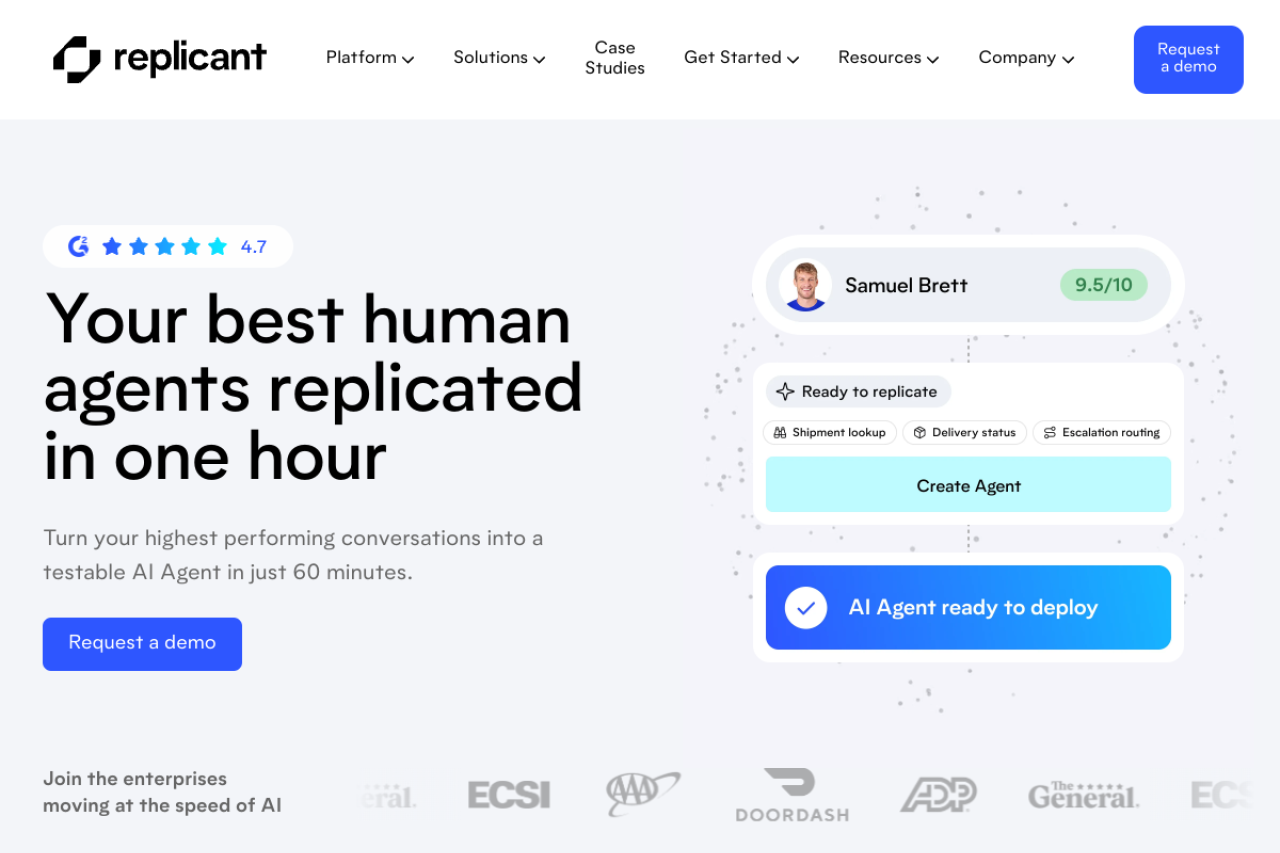
Replicant has been automating contact-center calls since 2017, which makes it the veteran of this list. It is built specifically for contact centers rather than adapted from a general voice API, so its supervisor tooling and integrations with platforms like Amazon Connect, Five9, Genesys, and Salesforce run deeper than the newer developer platforms.
Key features
- Thinking Machine platform. Voice agents that complete multi-step service tasks
- Deep integrations with Amazon Connect, Five9, Genesys, Avaya, NiCE CXone, Salesforce, Zendesk, and ServiceNow
- Inbound support automation plus outbound calling for collections, reminders, and follow-ups
- Call summaries, dispositioning, and analytics built for contact-center operations
- Purpose-built for tier-1 support queues and IVR replacement
Pricing
No public pricing; third-party sources describe usage-based pricing with six-figure annual contracts typical for enterprise deployments.
Pros
- The closest thing here to a drop-in replacement for traditional IVR inside existing CCaaS infrastructure
- Long track record with large enterprise deployments
- Integration list covers the telephony and CRM platforms support teams already use
Cons
- No public pricing and six-figure typical contracts put it out of reach for smaller teams
- Reviewers note complex installation and a slower update cadence than newer rivals
TAL’s Take
Replicant is the “rip out the IVR” vendor. If your contact center already runs on Five9 or Genesys and your leadership wants automation without replatforming, this is the shortest path. It will not win on novelty or price, but nine years of production call data is a moat that no 2024 startup can fake. Visit Replicant
8. Kore.ai
Kore.ai is the broadest platform on this list. Its XO Platform spans customer-facing agents, employee-facing agents, voice, chat, and search, with over 100 enterprise app connectors. The voice agent is one surface of a company-wide agent strategy rather than a standalone calling tool, which changes who should buy it. This one is for platform teams, not point-solution buyers.
Key features
- Multi-agent orchestration with specialized agents collaborating on complex objectives
- 100+ pre-built enterprise app connectors plus native AWS Bedrock and Amazon Connect integrations
- No-code, low-code, and pro-code development paths on one platform
- Enterprise RAG over internal data for grounded, accurate responses
- Voice automation, chat, and agent-assist under a single contract
Pricing
Standard plan is pay-as-you-go from a $100 minimum purchase, billed per 15-minute conversation session (reported around $0.20 per session), with $500 in free credits on signup. Enterprise contracts are custom and reported around $300,000/year.
Pros
- Broadest scope of the ten. Voice, chat, search, and employee agents under one roof
- Forrester Wave Leader for Conversational AI for Customer Service (Q2 2026)
- The $100 self-serve entry point is unusually accessible for an enterprise platform
Cons
- Steep learning curve frequently mentioned in buyer reviews
- Session-based billing can scale unpredictably for high-volume voice
TAL’s Take
Buy Kore.ai when the voice agent is chapter one of a bigger automation story. If you only need a phone agent, the platform’s breadth is overhead you will pay for and never use. But if your roadmap includes chat, agent-assist, and employee copilots, consolidating on one platform with one vendor relationship is genuinely cheaper than five point solutions. Visit Kore.ai
9. Yellow.ai
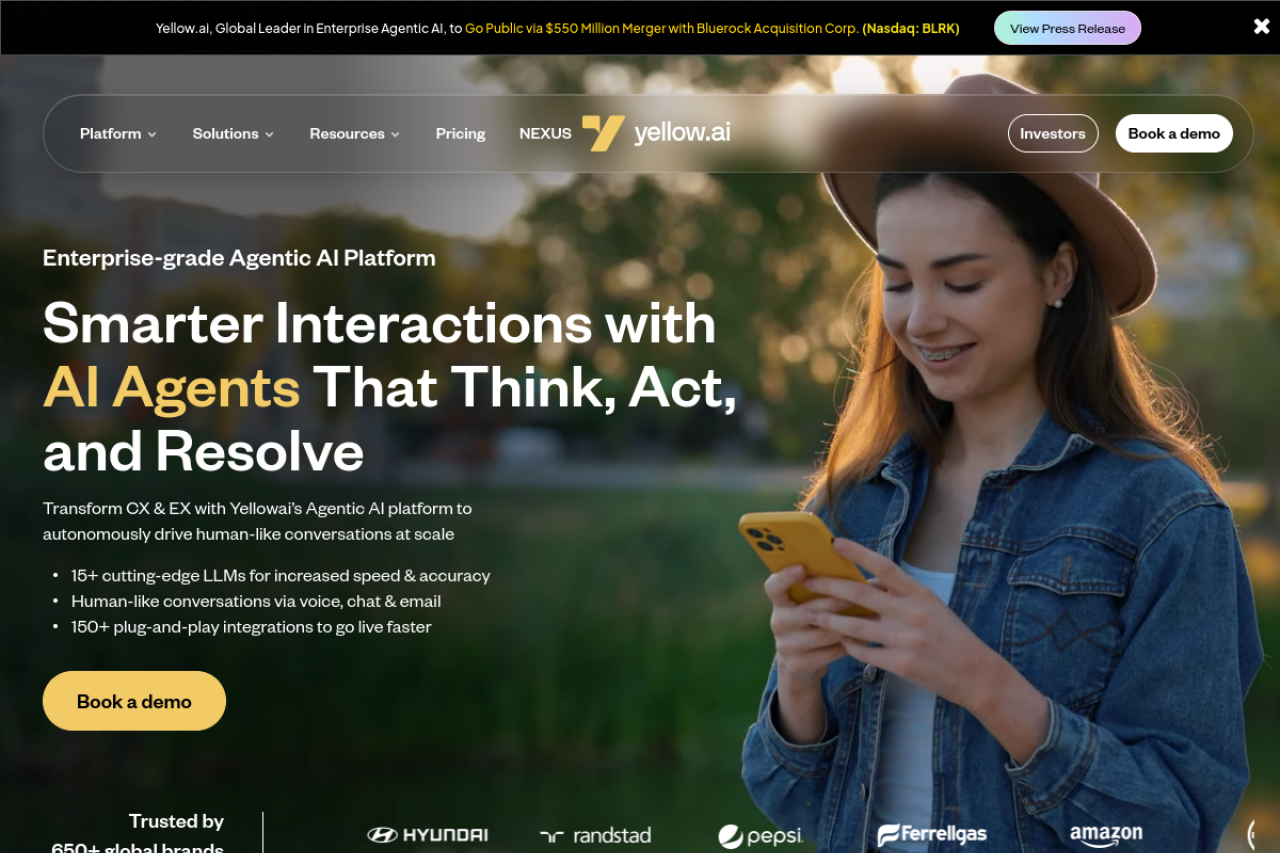
Yellow.ai is the scale play. It is an enterprise agentic AI platform operating across 85+ countries and 135+ languages, with particular strength in Asia-Pacific and the Middle East, where Western vendors are thin on the ground. Its 35+ channel coverage pairs voice with WhatsApp, which is where customer service actually happens across much of its footprint.
Key features
- Dynamic AI agents across 35+ channels, including voice and WhatsApp, in 135+ languages
- Proprietary multi-LLM engine trained on billions of enterprise conversations
- No-code and low-code automation platform with pre-built industry templates
- Voice AI for inbound support and outbound sales campaigns alongside chat
- 1,000+ enterprise customers including Domino’s, Hyundai, and Sephora
Pricing
Enterprise quote-only with no public pricing. In August 2026 the company announced a $550M merger to go public, which may improve pricing transparency over time.
Pros
- Unmatched emerging-market and multilingual footprint where competitors are thinnest
- Proven at genuine scale, with billions of conversations per quarter
- Industry templates shorten time to value for business teams
Cons
- Enterprise-only sales motion with no self-serve path
- Chat-first heritage means voice is newer and less battle-tested than pure voice platforms
TAL’s Take
Yellow.ai is the answer to a specific question. That question is “Which single vendor covers voice and WhatsApp in twelve languages across three continents?” If that is not your question, the platform’s strengths are wasted on you. If it is, there is no close second on this list. Watch the public listing, because newly public companies tend to get more transparent about pricing. Visit Yellow.ai
10. Cognigy
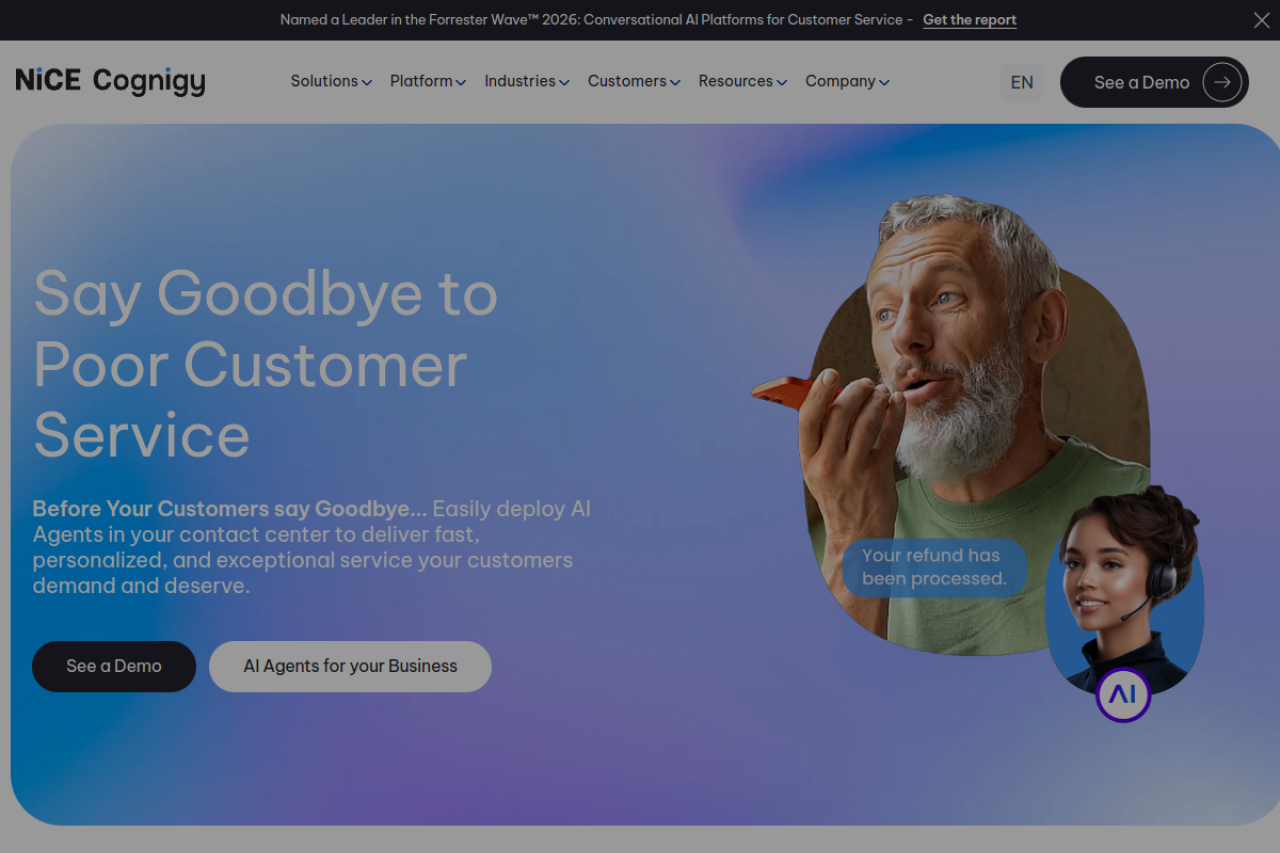
Cognigy pairs a genuinely good low-code visual builder with carrier-grade voice infrastructure, and its September 2025 acquisition by NiCE for $955M fused it with one of the largest contact-center software companies in the world. The result is the most designer-friendly enterprise voice platform here, now with a giant distribution engine behind it.
Key features
- Visual low-code agent builder with LLM orchestration (Nexus Engine)
- Dedicated Voice Gateway for telephony deployment with roughly 500ms reported latency
- 100+ language support across voice, chat, and messaging
- Agent-assist and analytics for hybrid human-plus-AI contact centers
- Available standalone or inside the NiCE CXone Mpower platform
Pricing
No public pricing. Third-party comparisons report enterprise contracts typically from $300,000/year. Quote-only.
Pros
- Low-code visual tooling makes it accessible to conversation designers, not just engineers
- 100+ languages and a dedicated Voice Gateway give it genuine voice-first credentials
- NiCE backing strengthens roadmap investment and distribution
Cons
- The NiCE acquisition creates roadmap uncertainty for buyers who valued Cognigy’s independence
- Fully opaque pricing with a small third-party review footprint
TAL’s Take
Cognigy is the sweet spot for European enterprises and existing NiCE CXone customers. It is visual enough for conversation designers and serious enough for carrier-grade telephony. The acquisition is both the bull case and the bear case. NiCE’s 25,000+ customers mean the product will be invested in; they also mean Cognigy now serves a master whose roadmap may not match yours. Ask hard questions about independence before signing. Visit Cognigy
Our Editorial Process
Every listicle on The AI Landscape follows the same process, because a ranking is only as trustworthy as the method behind it.
- How we select. We started with more than twenty voice AI vendors and filtered for platforms that are active, shipping, and genuinely usable for customer support or sales calls as of September 2026. Building blocks (Twilio, Cartesia, Hume) and adjacent products (conversation intelligence like Observe.AI) were excluded because they solve different problems.
- How we verify. For each finalist we checked the vendor’s own documentation and pricing pages, plus third-party buyer reviews on G2 and independent comparisons. Pricing figures carry a check date of 27 September 2026. Where vendors do not publish prices, we say so explicitly and label third-party estimates as estimates.
- How we evaluate. We evaluated docs, sandbox access, and review sentiment rather than vendor slide decks. Where we could not verify a claim independently, the article says so.
- How we stay independent. Rankings are editorial. Paid featured placements on this site are always labeled as sponsored and never influence the order or content of our reviews.
- How we keep it fresh. This article was published in September 2026 and is reviewed for pricing and product changes regularly. Voice AI pricing moves fast; if you spot something outdated, email us and we will correct it.
How to Choose the Best AI Voice Agent
There is no single best platform, but there is a best platform for your constraint. Work through these four steps in order.
1. Start with your budget reality
The market splits cleanly in two. Self-serve developer platforms (Retell, Vapi, Bland, ElevenLabs) get you to production calls for hundreds of dollars a month. Enterprise suites (Sierra, Replicant, Kore.ai, Yellow.ai, Cognigy, and now Synthflow) start in the five to six figures annually. Picking the wrong tier wastes more time than any feature comparison.
2. Match the tool to your hardest constraint
Regulated data? Bland. Voice quality as brand? ElevenLabs. No engineers? Synthflow. Existing contact-center stack? Replicant or Cognigy. Multilingual global scale? Yellow.ai. Company-wide agent strategy? Kore.ai. Pay-per-outcome economics? Sierra. Composable stack control? Vapi. Test-before-you-spend? Retell.
3. Pilot on resolution rate, not cost per minute
A $0.08/min agent that resolves 40% of calls is more expensive than a $0.14/min agent that resolves 70%. Run a shadow pilot on real call recordings, measure containment and escalation quality, and only then negotiate volume pricing.
4. Watch latency like a hawk
Anything above roughly 800ms of response delay starts feeling broken to callers. Every vendor claims sub-second latency; verify it on your own network, in your own languages, before signing.
Two broader insights from putting this list together. First, pricing is quietly migrating from per-minute to per-outcome, and Sierra will not be the last vendor to make that move. Buyers should learn to evaluate cost per resolution now, because that is where contracts are heading. Second, the simulation-testing idea that Retell pioneered is becoming table stakes. The vendors that let you break your agent in a sandbox before it meets customers will win the next wave of deals.
Run an AI voice agent company that belongs on this list? Email us to get featured. Featured placements are always labeled and never affect our editorial rankings.