
It was a regular Saturday morning at Verve Coffee Roasters near Stanford’s campus. A 23-year-old PhD student sat at the communal table with a stack of math papers, the way she did most weekends. She struck up a conversation with a stranger sitting nearby. He turned out to be an AI researcher at Meta. That conversation changed the direction of her life.
Her name is Carina Hong. And while most AI startups today are racing to build better chatbots and coding assistants, she is pursuing something much harder: teaching AI to actually prove things are true, not just sound convincing.
Hong grew up in Guangzhou, China. She taught herself English so she could read advanced math textbooks that were not available in Chinese. She competed on her provincial Math Olympiad team, one of only four girls on it. From there she went to MIT, then Oxford as a Rhodes Scholar, then Stanford for a joint PhD in math and a law degree. On paper, she was on track for a long academic career.
Instead, less than a year after that coffee shop conversation, she dropped out of Stanford, started a company called Axiom Math, and built a team pulled from Meta and Google DeepMind. Her pitch was simple but bold: most AI today produces answers that look right. Hong wanted to build AI that can prove its answers are right, using the same rigor mathematicians have used for centuries.
That bet has paid off fast. Axiom’s system has posted a perfect score on one of the hardest math exams in the world, cracked open problems that stumped human mathematicians for years, and pushed the company to a $1.6 billion valuation in about a year.
In this founder spotlight, we look at Carina Hong’s journey from a Stanford PhD student to the founder of one of AI’s most closely watched startups, and how she turned an unpaid weekend habit of reading math papers into a company that could change how we trust AI-generated work.
The Making of a Mathematician
Born in Guangzhou, China, Carina Hong discovered her passion for mathematics through a free Olympic math training program in middle school. Instead of focusing on memorization, the program challenged students to solve complex problems creatively. By high school, she was one of only four girls representing Guangdong province at the China Mathematical Olympiad, competing alongside some of China’s brightest young mathematicians.
At just 17 years old, Hong entered MIT in 2018, where she double-majored in Mathematics and Physics. She completed both degrees in only three years, authored nine research papers, and took twenty advanced mathematics courses. Her outstanding achievements earned her the 2023 Frank and Brennie Morgan Prize, the highest honor awarded to an undergraduate mathematician in North America.
Hong’s academic journey continued as a Rhodes Scholar at the University of Oxford, where she earned a master’s degree in Computational Neuroscience. She later enrolled as a PhD candidate in Stanford University’s Department of Mathematics while simultaneously pursuing a Juris Doctor (JD) at Stanford Law School through the prestigious Knight-Hennessy Scholars program.
Despite excelling at every stage, Hong has spoken openly about how different research felt from competition math. She described Olympiad problem-solving as “a continuous dopamine hit,” while research mathematics often felt like “banging your head against a wall full of pain and struggle.” That realization would eventually inspire her to leave academia and pursue a much bigger challenge.
The Coffee Shop Moment
The idea for Axiom Math took shape at Verve Coffee Roasters near Stanford, where Carina Hong often worked from a shared table. There, she met Shubho Sengupta, an AI researcher at Meta who was building large language models for software testing. Their conversations soon shifted to a much bigger goal: building AI that could solve some of the world’s hardest math problems and even discover new ones.
As Hong was deciding whether to leave Stanford, she remembered advice from AMD CEO Lisa Su to run toward the hardest problems. That idea gave her the confidence to take the leap. She left academia to start Axiom Math, and Sengupta became the company’s first hire and later its CTO.
A Calculated Leap, Not a Risky One
Carina Hong founded Axiom Math in March 2025, but she did not leave Stanford immediately. Instead, she stayed focused on building the company and raising capital before making the decision to step away from academia.
The company closed a $64 million seed round in October 2025, led by B Capital, at a valuation of around $300 million. Only after the funding was secured did Hong officially leave her PhD program.
This detail makes her story different from the typical “just take the leap” startup advice. She did not quit first and hope investors would back her vision later. She built momentum, secured committed funding, and then made the transition. It was a calculated decision that reduced risk while giving Axiom Math the resources it needed to pursue an ambitious goal.
What Exactly Is Axiom Math?
Axiom Math is an AI startup focused on one of the hardest problems in artificial intelligence. Instead of building another chatbot, the company is developing AI that can solve complex mathematical problems, generate detailed proofs for every step, and verify its own work.
In an interview with Forbes, Carina Hong explained the company’s vision: “We’re not building another chatbot that mimics solutions. We’re teaching AI to prove theorems. That’s a fundamentally different challenge and one worth pursuing.”
To achieve this, Axiom Math trains its models to produce formally verified proofs using Lean, a programming language designed for mathematical theorem proving. This means every step of the AI’s reasoning can be checked by a computer and proven to be logically correct, rather than simply being the most likely answer.
If successful, this technology could have applications far beyond mathematics. It could help verify software, strengthen cryptography, improve financial systems, support scientific research, and make AI more reliable in fields such as robotics and engineering.
Building a Team of World-Class Researchers
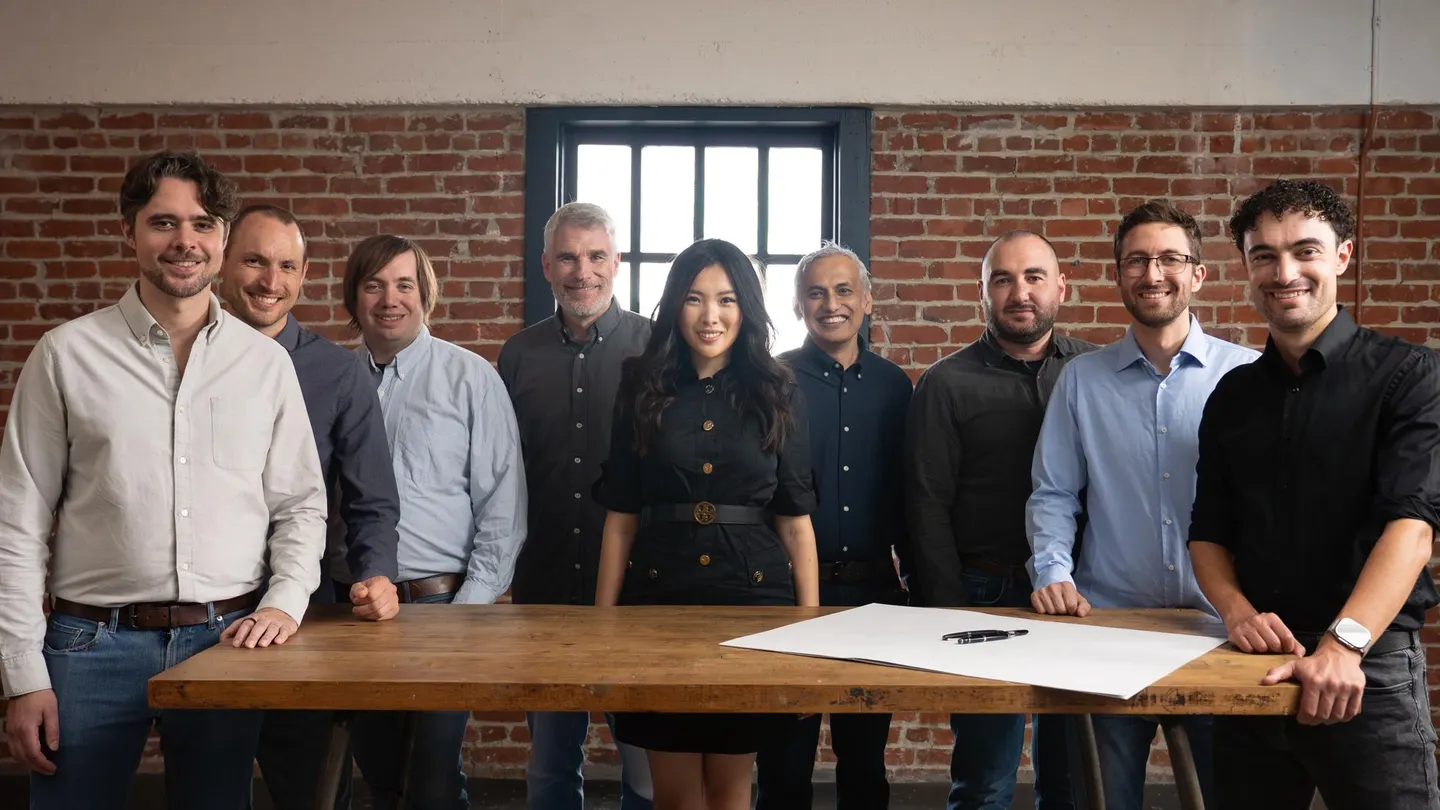
One of Carina Hong’s biggest achievements was convincing some of the world’s top AI researchers to join Axiom Math. In less than a year, she built a team of 17 employees, recruiting talent from Meta’s Fundamental AI Research (FAIR) lab, Meta GenAI, and Google Brain, which later became part of DeepMind. By March 2026, the company had grown to more than 30 people.
The team includes respected researchers such as Francois Charton, known for solving a 100-year-old mathematics problem using AI, and Aram Markosyan, who previously led AI safety and fairness research at Meta.
Perhaps the most significant hire was Ken Ono, one of the world’s leading number theorists and Hong’s former mentor. He joined Axiom Math as its Founding Mathematician, saying, “I’m not doing this for money.” His decision reflected a belief in the company’s long-term mission.
For many startups, funding attracts attention. But for deep technology companies like Axiom Math, the stronger signal is whether respected experts are willing to leave established organizations and join the mission. In Axiom’s case, they did.
From Stealth Startup to AI Unicorn
Axiom Math was founded in March 2025 with a bold goal of building AI capable of mathematical reasoning. The company quickly attracted investor interest, raising a $64 million seed round backed by Menlo Ventures, B Capital, Greycroft, and Madrona.
The startup’s progress soon matched the excitement around its vision. In December 2025, AxiomProver achieved a perfect score on the Putnam Competition, one of the world’s toughest undergraduate mathematics exams. Only six perfect scores have been recorded in the exam’s 98-year history, despite more than 150,000 attempts. For comparison, the median human score on the Putnam is zero.
Just two months later, in February 2026, AxiomProver generated proofs for several previously unsolved mathematical problems, including one related to the work of Srinivasa Ramanujan. The results were published on arXiv, drawing attention from the mathematics and AI research communities.
In March 2026, Axiom Math raised a $200 million Series A led by Menlo Ventures, valuing the company at $1.6 billion. That represented a 5.3x increase in valuation in less than six months, making Axiom Math one of the fastest AI startups to reach unicorn status.
The Real Lesson From Carina Hong’s Journey
Carina Hong’s story is not about taking blind risks or following passion without a plan. It is about solving a problem that very few people are willing to tackle and doing it with patience, preparation, and conviction.
While many AI startups are competing to build better general-purpose assistants, Hong chose one of the narrowest and most difficult areas in AI: formal mathematical proof verification. That clear focus became one of Axiom Math’s biggest strengths. It gave the company a unique direction and convinced world-class researchers to leave established organizations and join a startup with an ambitious vision.
Her journey also challenges one of the most common pieces of startup advice. She did not quit first and hope funding would follow. She built the company, raised $64 million in committed capital, and only then left academia. It was a calculated decision that reduced risk while giving the company a strong foundation.
Perhaps the boldest part of her story is that she questioned the very benchmarks that much larger AI companies were celebrating. While others focused on bigger models and higher benchmark scores, Hong argued that the real challenge was building AI that could prove its answers instead of simply generating convincing ones. She chose to work on a problem that was harder to solve, harder to explain, and impossible to fake.
For aspiring founders, that may be the biggest takeaway. You do not need to chase the biggest market or the loudest trend. Sometimes, the strongest companies are built by identifying an overlooked problem, saying the difficult thing that others avoid, and solving it better than anyone else.