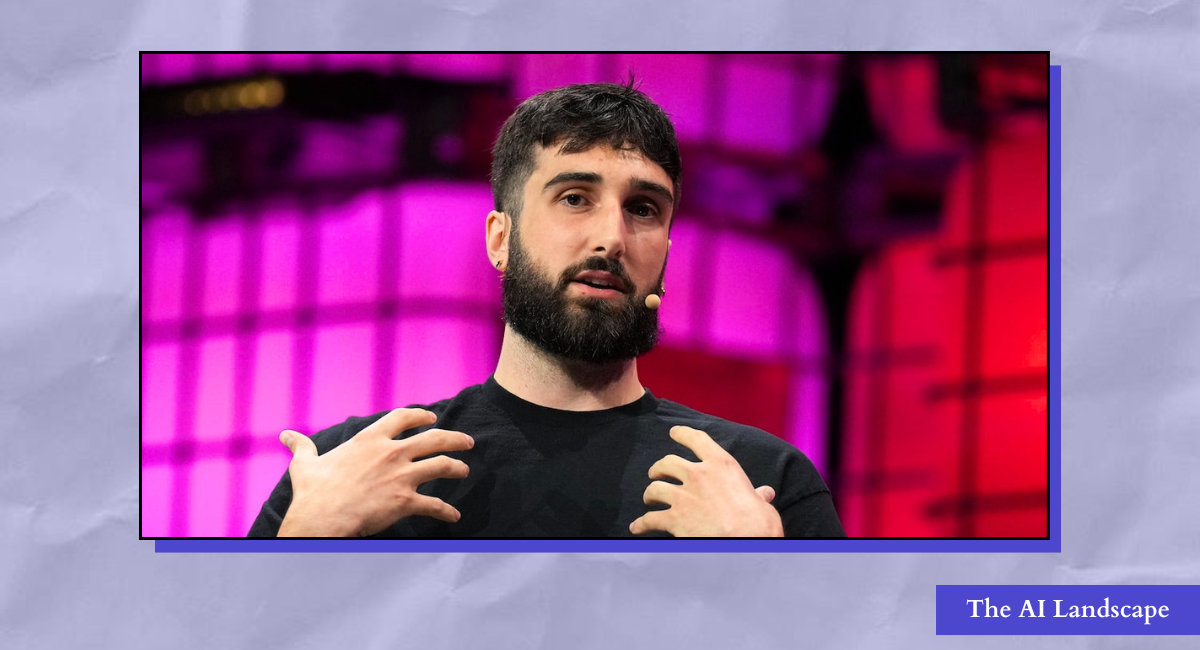
In 2017, long before ChatGPT became a household name, a Toronto researcher named Aidan Gomez co-authored “Attention Is All You Need.” The paper introduced the Transformer architecture, a breakthrough that changed the future of artificial intelligence. It became the foundation for modern AI models including GPT, ChatGPT, Claude, Gemini, and almost every large language model used today.
Most people would assume that someone who helped create the technology behind ChatGPT would go on to build the next big chatbot. But Aidan Gomez chose a different path.
Instead of competing in the consumer AI race, he co-founded Cohere to build AI for businesses, governments, and other regulated industries. This is the story of why he made that decision, how it shaped Cohere’s journey, and why that early bet is paying off today.
Three Researchers, One Shared Vision
After his breakthrough research, Aidan Gomez teamed up with Nick Frosst and Ivan Zhang, two fellow AI researchers from Geoffrey Hinton’s research circle in Toronto. Together, they made a bet before it was obvious that enterprises, not consumers, would become the biggest market for AI. That belief would eventually become the foundation of Cohere.
Although they shared the same vision, each founder had a different journey into AI. Gomez was the researcher behind one of the most influential AI papers ever published. Frosst studied computer science and cognitive science at the University of Toronto before joining Geoffrey Hinton’s team at Google Brain.
Alongside his research career, he also performed as the lead singer of the indie rock band Good Kid. Zhang took a less conventional route. He dropped out of the University of Toronto to join a genomics startup but continued teaching himself deep learning by spending evenings at Google Brain, where his dedication eventually caught Hinton’s attention.
By 2019, the three founders noticed something that much of the AI industry had overlooked. Researchers were making language models more capable every few months, but very few businesses had the expertise, computing power, or resources to use them effectively. Instead of building another AI application, they decided to build the infrastructure that businesses could easily plug into, making advanced AI far more accessible for enterprise use.
Building for Enterprises Before It Was Popular
From the beginning, the founders chose to build for enterprises instead of consumers. Their belief was simple. Most businesses didn’t want to build and maintain their own AI models. They wanted reliable AI that could fit into their existing products and workflows.
The founders compared it to electricity. Most companies don’t build their own power plants. They simply connect to the grid and pay for the electricity they use. They believed AI would work the same way. Businesses wouldn’t want to train their own language models or manage the infrastructure behind them. Instead, they would access powerful AI through an API and use it whenever they needed it.
That simple idea became Cohere.
Looking back, it seems like an obvious business model. But in 2019, it was anything but. GPT-3 had not been released, ChatGPT was still three years away, and the AI chatbot race had not even begun. While much of the industry was focused on advancing AI research, Cohere was focused on making that research useful for businesses. It was an early bet that enterprise AI would become a much bigger opportunity than consumer applications, and the years that followed proved them right.
What Exactly Is Cohere?
Cohere is an enterprise AI company that helps businesses build AI-powered products without creating their own large language models. Through its APIs and enterprise platform, companies can add capabilities like text generation, document search, summarisation, multilingual support, and AI assistants to their applications.
Unlike consumer AI companies that focus on chatbots, Cohere is designed for organisations that need security, privacy, and control over their data. Its models can be deployed through the cloud, private environments, or on-premises infrastructure, making them suitable for banks, healthcare providers, governments, and other regulated industries.
Cohere’s Early Journey
Cohere’s first funding came from Toronto-based Radical Ventures, a venture capital firm that has backed several leading AI startups. Soon after, some of the biggest names in artificial intelligence, including Geoffrey Hinton, Fei-Fei Li, Ian Goodfellow, Pieter Abbeel, and Raquel Urtasun, invested in the company. Their backing reflected strong confidence in both the founders and their enterprise-first vision.
Its customers included banks, governments, healthcare providers, financial institutions, defence organisations, and other regulated industries. These organisations cared more about privacy, security, compliance, and deploying AI within their own infrastructure than building consumer chatbots.
The founders also faced a major decision early in the company’s journey. At one point, Cohere received a nine-figure acquisition offer and came very close to accepting it. However, they ultimately chose to remain independent. Years later, Aidan Gomez said that selling the company would have been a failure because their goal was to build an independent Canadian AI company, not another startup that ended with an acquisition.
Over the following years, the company raised funding from investors including Index Ventures, Tiger Global, Nvidia, Oracle, Salesforce, and others. By 2025, it had raised more than $1.5 billion.
The business also began to scale rapidly. Cohere’s annual recurring revenue reportedly increased from around $22 million in early 2024 to approximately $240 million in 2025. The growth showed that businesses were willing to invest heavily in enterprise AI platforms that offered security, reliability, and greater control over their data.
From Startup to Global AI Leader
As Cohere grew, it attracted funding from some of the biggest names in technology and venture capital, including Index Ventures, Tiger Global, Nvidia, Oracle, and Salesforce. By 2025, the company had raised more than $1.5 billion to expand its enterprise AI platform.
The business also scaled rapidly. Cohere’s annual recurring revenue reportedly grew from around $22 million in early 2024 to approximately $240 million in 2025. The growth showed that businesses were willing to invest in AI platforms that offered security, reliability, and greater control over their data.
Governments also began recognising the importance of AI sovereignty. Canada committed hundreds of millions of dollars to support Cohere as part of its sovereign AI strategy, reinforcing the founders’ early belief that organisations wanted AI they could control while keeping their data secure.
In 2026, Cohere announced plans to acquire German AI company Aleph Alpha. The deal strengthens its position in Europe, where governments and enterprises increasingly prefer AI systems that meet local data regulations. It also adds expertise in multilingual and smaller language models, further strengthening Cohere’s enterprise offerings. The transaction is currently awaiting regulatory approval.
A Lesson in Long-Term Thinking
Today, Cohere is preparing for its next chapter, with reports suggesting the company is laying the groundwork for a future IPO.
Its journey is a reminder that not every AI success story was built around consumer chatbots. While many companies focused on winning the chatbot race, Cohere quietly built the infrastructure that businesses, governments, and regulated industries needed.
Aidan Gomez, alongside Nick Frosst and Ivan Zhang, chose to focus on long-term enterprise value over short-term hype. Years later, that decision has made Cohere one of the world’s leading enterprise AI companies.