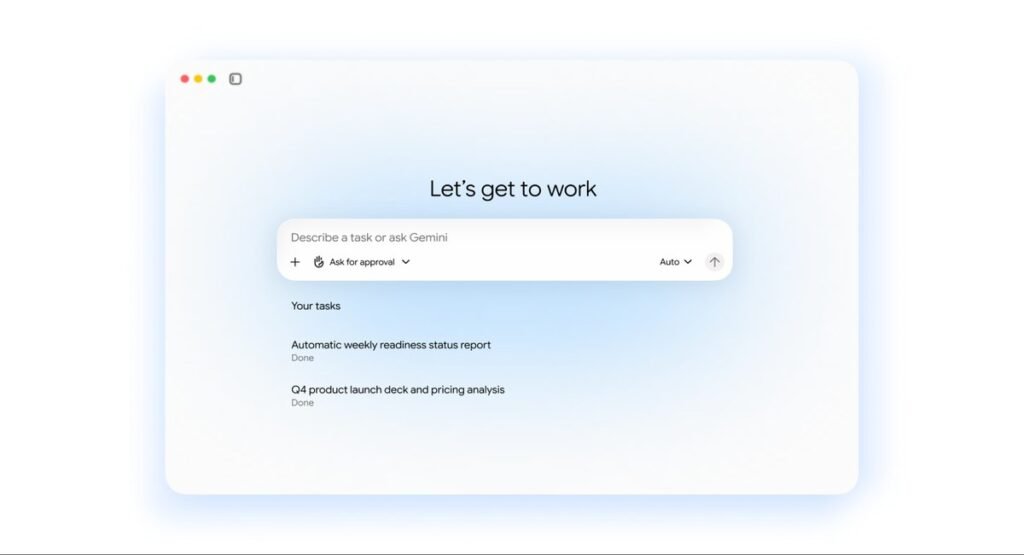
Google is turning Gemini into an agent for work. The company announced on October 8 at its Gemini at Work 2026 event that Gemini is becoming a single, universal agent that answers questions, handles knowledge work, creates content, and writes and runs code from one prompt box. Businesses get it first.
“Today, Gemini becomes an agent,” Google Cloud CEO Thomas Kurian said at the event. “You give it objectives, not just instructions. It plans the work, uses custom skills and tools, connects to your systems, and brings back something finished.”
The idea is that you hand Gemini an outcome rather than step-by-step instructions. The agent plans the work, picks the right tools and skills, connects to company systems, and returns finished work inside the documents, inboxes, and developer environments people already use.
One agent across all your work apps
The agent works directly inside Gmail, Drive, Docs, Slides, Sheets, Chat, and Calendar, carrying the same memory and context across all of them. It can also be reached from Slack, Microsoft 365, and the command line. Because it runs in the cloud, long jobs keep running after you close your laptop, and it can spin up temporary sub-agents to split multi-step tasks that take hours or days.
For data work, Google is giving Gemini domain-specific skills. Business users can ask plain-language questions and get operational reports built on BigQuery, while data engineers can have it generate PySpark code, train models, and fix pipeline issues on its own.
It runs on Claude too
In a notable move, the agent is model-agnostic. It runs each job on the model that fits best, orchestrating across Google’s own Gemini models and Claude models from Anthropic today, with more models to be added later. Google says matching the model to the work raises accuracy on hard jobs and lowers cost on simple ones.
Cost control is a big part of the pitch. The agent includes Smart Routing, which automatically sends each workload to the cheapest model that can handle it, plus real-time spend caps that pause a project’s agent when it hits a budget limit. “It chooses the best model for the job, has built-in cost controls, and most importantly, has the security, administration, and governance required by your company,” Kurian wrote in the announcement.
Coworker agents with their own email addresses
Companies can also create coworker agents that act as team members. Each one gets its own Workspace identity, including an email address, calendar, Drive storage, and a presence in the company directory. Colleagues add them to Chat spaces or @mention them in documents, and they show up under their own name in version history. They only see the information the team shares with them.
Google is also rolling out industry-specific versions. Gemini for Financial Services and Gemini for Legal are in preview now, with versions for government, healthcare, and retail coming later. The financial services version draws on data from FactSet, LSEG, S&P Global, and SEC filings, and is already being used by CME Group and Deutsche Bank, according to Google.
The agent race heats up
Google is entering a crowded field. OpenAI launched Dots, its always-on workplace agents, and Manus launched Cue, agents with their own phone number, wallet, and computer. Google’s answer leans on distribution. Nearly 80% of Google Cloud customers already use its AI products, and almost 90% of the Fortune 100 use Gemini Enterprise, the company says.
Early results cited by Google include Brazilian bank Bradesco cutting document review time from one hour to five minutes, and Orange Spain deploying more than 1,000 custom Gemini Enterprise agents. Under the hood, the agent runs on Google’s latest models, including Gemini 4 Argon, its newest flagship.
Today at Google Cloud’s Gemini at Work event, we announced Gemini, a new single universal agent for work that has all of your business context and can be used for everything from knowledge work to answering questions, and content creation to coding, all from a single prompt box.… pic.twitter.com/2Z1PZg74Ui
— Thomas Kurian (@ThomasOrTK) October 8, 2026