Maple has raised $5.3 million in an oversubscribed seed round led by EPIC Ventures. The privacy focused AI startup announced the round on 24 November, with Draper Associates, Planetary VC and Epoch VC joining as participants.
The company builds AI products that cannot read user data, not even its own. The new money will fund a cloud based agent that keeps working when a computer is switched off, along with a bigger team and faster access to new open models.
What the money will fund
Maple plans to grow its team across engineering, growth and operations. It will also add capacity so new open models reach users sooner, and it will keep developing Maple Work and Maple Teams for businesses of every size.
The round follows a pre-seed angel round of under $1 million. Maple plans to raise a Series A in the first half of 2027, citing strong investor interest in the seed round.
How Maple keeps data private
Maple runs open models inside trusted execution environments, which are servers with hardware encryption. Messages are encrypted on the user device with a password only the user knows, then decrypted inside that hardware for processing and encrypted again before being sent back.
The company says it has no access to raw data while it is being processed or stored. If hackers breached its systems or the government arrived with a subpoena, all it could hand over is an encrypted file.
Users can check the claim themselves. The hardware publishes proof of the exact code it runs, which anyone can verify at maple.ai/proof. Maple also publishes its code as open source, and it says it never trains models on user chats or sells data to third parties.
What Maple builds
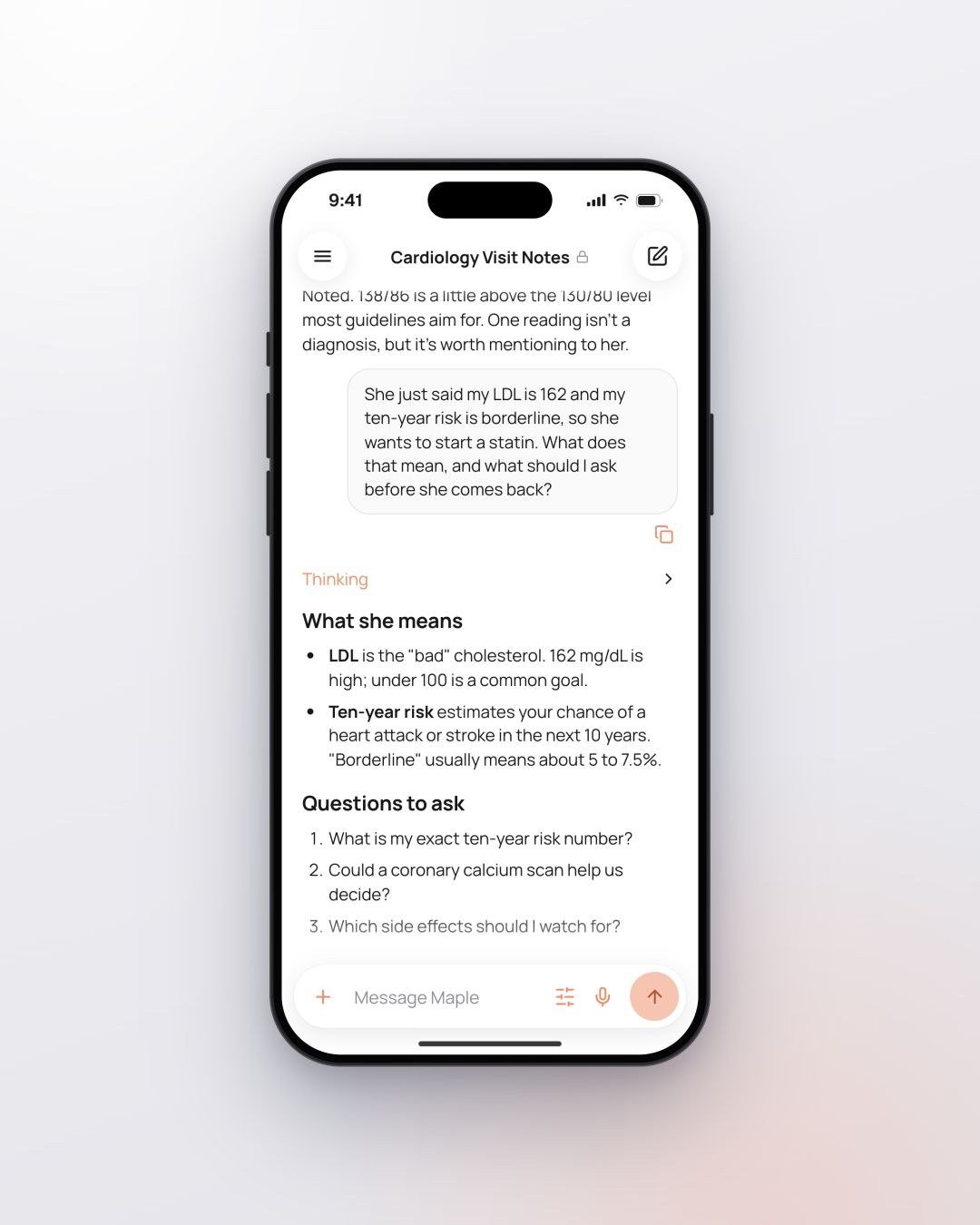
Maple Chat is a chat app for phones, desktop and the web. It runs open models chosen by the user, including versions of DeepSeek, Kimi, GLM, Inkling from Thinking Machines, Google Gemma and OpenAI GPT OSS. Users can switch between a quick model and a more powerful one.
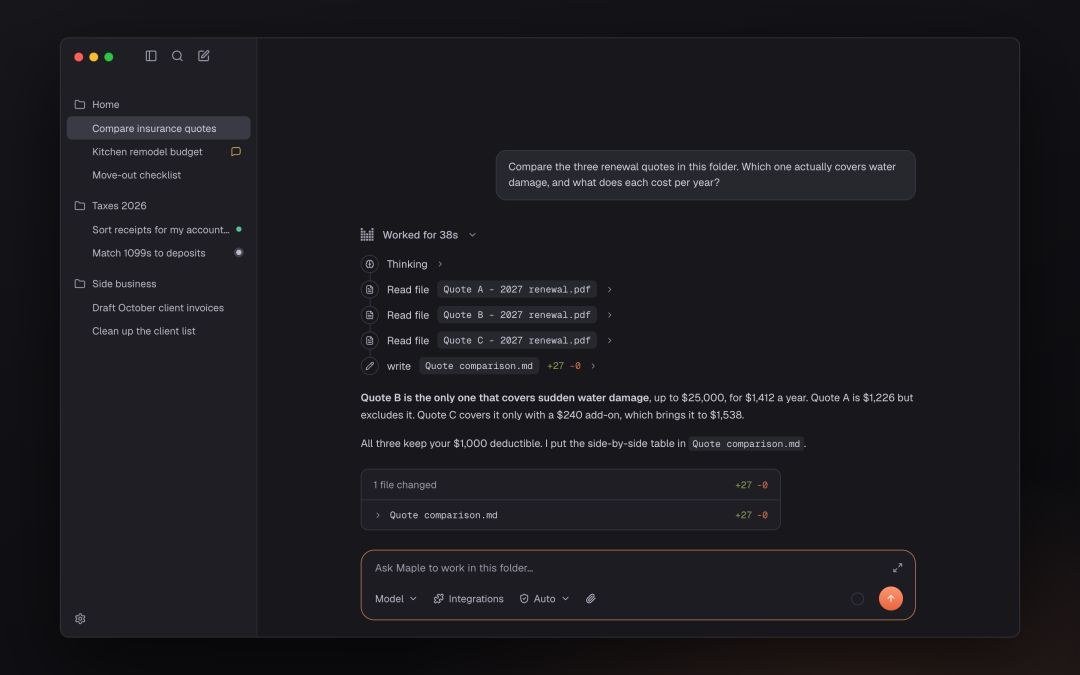
Maple Work is a newer desktop app that acts as an agent. It can control the computer, work with files and apps, and use the browser to finish online tasks.
It connects to tools such as Gmail, calendars, Stripe, Notion and Dropbox. It can also run a subagent inside other desktop AI apps, sharing only the information needed for the task.
Maple also sells subscriptions. Its Pro plan costs $20 a month, with Max plans at $100 and $200 a month. The company says daily encrypted AI usage on Maple has grown 60 times over the past three months, though it declined to share registered customer numbers.
Who is behind Maple
Maple was co-founded by Mark Suman and Anthony Ronning. Suman, the chief executive, spent six years at Apple working on AI and machine learning with a focus on computer vision and privacy. Ronning, the chief technology officer, has more than a decade of experience building infrastructure at startups, with deep experience in security and networking.
Ronning started the company that later became Maple in 2023, first as a privacy focused fintech. Suman joined him in August 2024, and the product became available to the public as a mobile app in January 2025. The startup is based in Austin, Texas, with a team of four that is actively hiring.
What the founders said
“We wanted to build something that was not only encrypted but also could be proven, and that people could go look at the open-source code, and then they could look at what we call trusted execution environments.”
Mark Suman, co-founder and CEO, Maple
Suman added that users can audit everything themselves and know how their data is being handled. He said the company simply does not want access to customer data, and that keeping it out of reach is a deliberate part of how Maple is built.
What to watch next
The cloud agent is the clearest test of the round. It would let Maple compete with consumer AI services that keep working around the clock, while keeping its promise that the company itself cannot see the data involved.
Maple also plans enterprise pilot work next year, with its own version of zero data retention, and it is completing SOC 2 compliance and security audits first. See the latest startup rounds on our funding tracker.