Meta has quietly launched a new AI-powered app called Pocket, but unlike most product launches, it did not announce it through a press release, blog post, or keynote.
Instead, the app was first spotted by reverse engineer Alessandro Paluzzi, who shared screenshots from the Google Play Store on X. That is how the wider tech community discovered it.
#Meta is working on a new app called Pocket 👀
ℹ️ A new creative platform to make and share gizmos. pic.twitter.com/zFjMU5jj1U
— Alessandro Paluzzi (@alex193a) July 2, 2026
This quiet rollout is becoming a familiar strategy for Meta. Rather than building hype before launch, the company is increasingly releasing products to a limited audience, collecting real-world feedback, and expanding only if users respond positively.
What Pocket Actually Does
Pocket is an AI-powered platform that lets users create small interactive apps and games using simple text prompts.
Meta refers to these creations as “gizmos.” According to the app’s description, Pocket is “a creative platform for making and sharing gizmos.”
The app also includes a discovery feed where users can browse and play creations made by other people. This combination of AI creation and social discovery makes the experience feel more like TikTok or Instagram Reels, except the content consists of playable AI-generated experiences instead of videos.
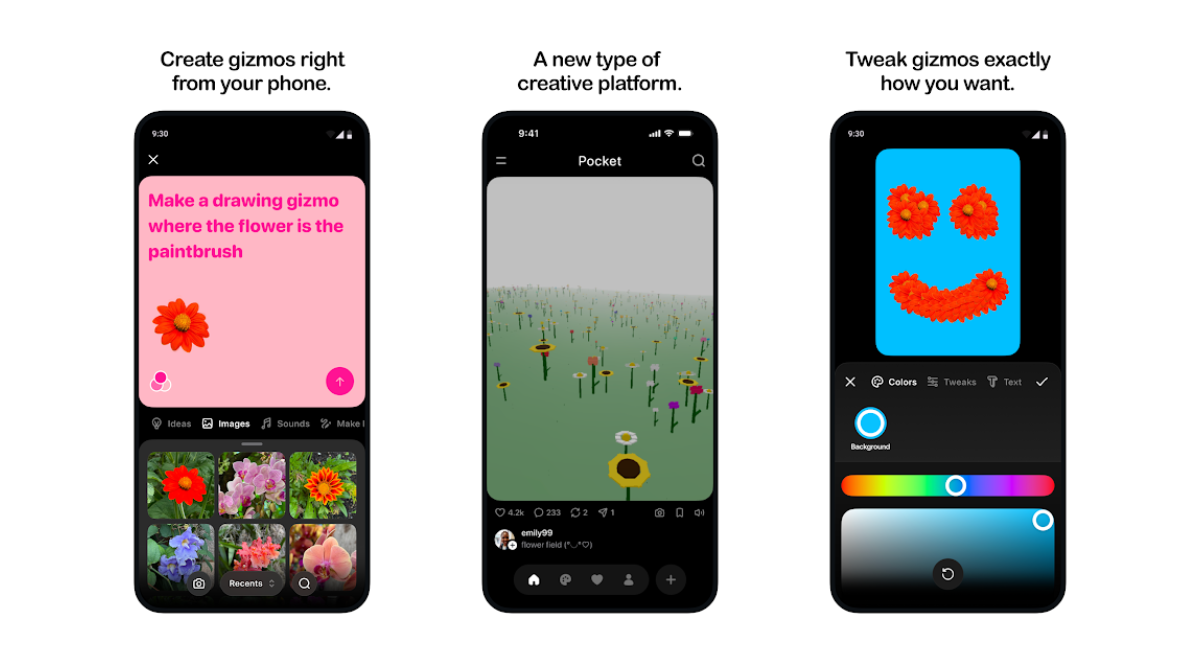
If the concept sounds familiar, that is because Pocket closely resembles Gizmo, the AI creation platform Meta acquired earlier this year. Even if you look at the Play Store URL, it says “https://play.google.com/store/apps/details?id=com.facebook.gizmo” .
Both apps follow the same core idea. Users describe what they want, AI generates an interactive experience, and the results are shared through a public feed.
Interestingly, Gizmo has not been replaced. Both Pocket and the original Gizmo app remain available on the Google Play Store, suggesting Meta may be experimenting with different branding, features, or audiences before deciding on a long-term direction.
Pocket also requests access to the camera and photo library during setup. While Meta has not explained why, these permissions suggest the company could eventually introduce camera-based experiences, AI filters, or augmented reality features beyond simple mini games.
Why Meta Is Launching Pocket Now
Pocket fits neatly into Meta’s broader AI strategy this year.
Following the Gizmo acquisition, its team was integrated into Meta Superintelligence Labs, the division leading many of Meta’s next-generation AI projects. This includes Muse Spark, one of the first models developed under Meta’s reported $14.3 billion investment into building superintelligence capabilities.
Pocket is also arriving alongside several other quietly released products. In recent weeks, Meta introduced Forum, a Reddit-style community app built around Facebook Groups, and Instants, a disappearing photo-sharing app. Reports suggest that CEO Mark Zuckerberg has encouraged teams to move much faster, arguing that AI tools now allow engineers to build and launch products significantly more quickly than before.
Pocket is therefore not an isolated experiment. It is part of a much broader shift toward rapid AI-driven product development.
There Is Already Evidence People Like This Format
Pocket is not based purely on speculation.
According to Appfigures data, Gizmo has generated approximately 635,000 lifetime installs across iOS and Android while maintaining an impressive 98% positive sentiment score.
Those numbers indicate genuine user interest in AI-generated interactive experiences. Although the category is still new, it has already shown enough traction to justify further investment from Meta.
Pocket appears to build directly on those early results rather than starting from scratch.
The Bigger Question Is Whether AI Mini Games Can Become Mainstream
The biggest uncertainty is not whether AI can generate these experiences. It is whether people want a dedicated feed filled with AI-created mini games.
Early adopters are likely to be AI enthusiasts and testers rather than mainstream gamers. Reports also suggest Pocket is currently available only in selected countries, indicating that Meta is running another controlled rollout before expanding globally.
However, Meta has one advantage that few competitors can match.
With billions of users already using Facebook, Instagram, WhatsApp, and Messenger every month, Meta does not necessarily need Pocket to be the best AI gaming platform from day one. If it decides to integrate Pocket’s technology into its existing ecosystem, it can instantly expose the experience to an audience that most startups could never reach.
Launching quietly also gives Meta room to experiment without creating unrealistic expectations or attracting unnecessary competitive pressure. If Pocket succeeds, Meta can scale it rapidly. If it fails, the company can iterate behind the scenes with little public attention.
That increasingly appears to be Meta’s AI playbook. Build quickly, launch quietly, measure real user behaviour, and only invest heavily once the data proves people want the product.