Meta has its first frontier AI model. On Monday, the company’s Superintelligence Labs released Muse Wonder and Muse Wonder Full, which it describes as its most capable models to date and competitive with the best systems from OpenAI and Anthropic.
The announcement caps a 14-month overhaul that began when Mark Zuckerberg dissolved Meta’s old AI org chart, invested $14 billion in Scale AI, and hired its co-founder Alexandr Wang to run the new division.
The launch even came with a teaser. Hours before the announcement, Zuckerberg posted a picture of a watermelon on Threads, which he said his own Muse AI assistant had sent him. The model was developed under the codename Watermelon, Wang later confirmed in interviews.
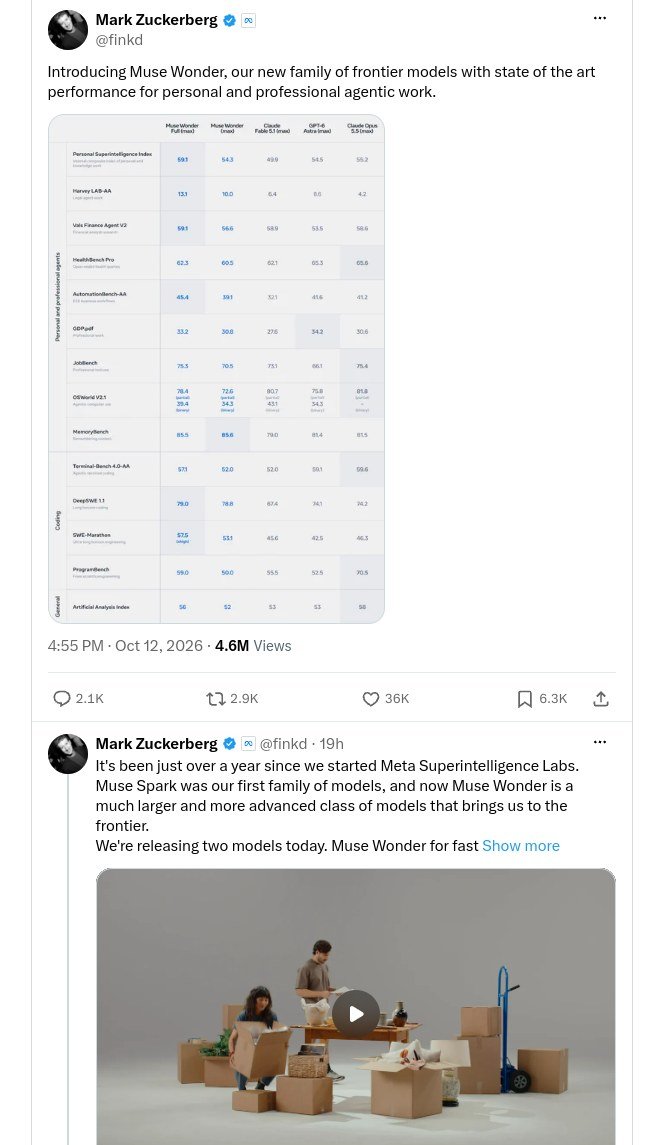
Introducing Muse Wonder, our new family of frontier models with state of the art performance for personal and professional agentic work. pic.twitter.com/NKHrybrGKQ
— Mark Zuckerberg (@finkd) October 12, 2026
Fourteen months to parity
Zuckerberg framed the release as the payoff of that rebuild. “It’s been just over a year since we started Meta Superintelligence Labs.
Muse Spark was our first family of models, and now Muse Wonder is a much larger and more advanced class of models that brings us to the frontier,” he wrote. “We’re releasing two models today. Muse Wonder for fast frontier performance and Muse Wonder Full for the full version of the model.”
Both models were trained at Prometheus, Meta’s gigawatt-scale data center in Ohio, using advances in pretraining and reinforcement learning. “Today, Meta is introducing the Muse Wonder series with Muse Wonder and Muse Wonder Full, our most capable models to date, built on the groundwork we laid with Muse Spark,” the company said in its announcement.
Built for agents that stick around
The pitch is not raw chat ability but sustained agentic work. Two features carry the marketing. Active Memory lets the model retain and synthesize what a user tells it across conversations. Active Focus keeps it grinding on hard goals, trying new approaches when one stalls, recovering from errors, asking for clarification, and checking in before consequential actions.
“We put a tremendous amount of effort into making sure your model can remember what’s important to you over days, weeks, months, and beyond,” research scientist Kavya Kopparapu said in the launch video.
The models target expert-level work in law, finance, and health alongside coding, from parsing a lease to debugging across large codebases.
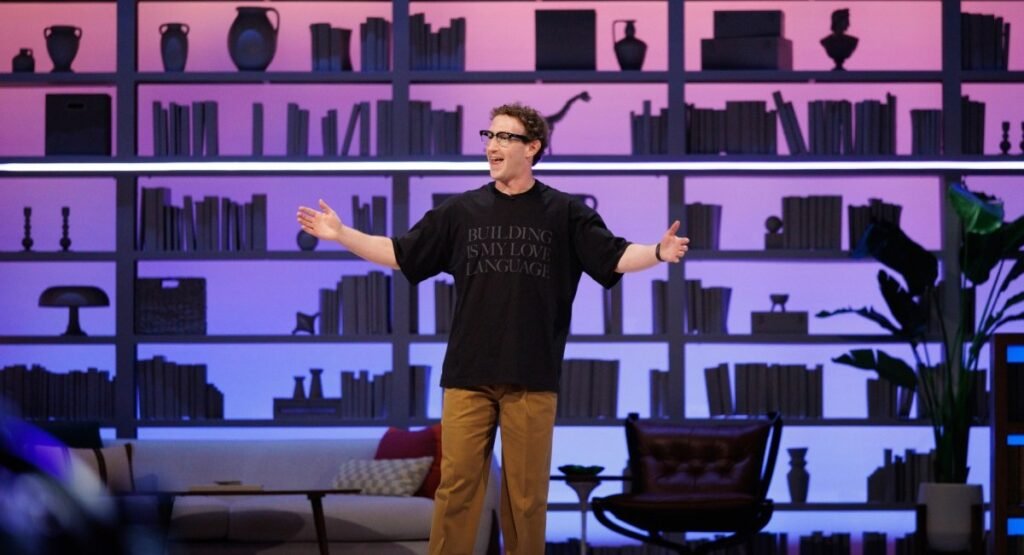
Muse Wonder is available now through the Meta Model API and Muse Code, and will roll into the Muse personal agent with subscribers getting it first. The agent’s default avatar is Jolly, the plush-like mascot Zuckerberg showed off on stage at Meta Connect in September. The bigger Wonder Full is locked to Muse Code subscribers and will not be served through the API at all.
Parity, not a leapfrog
Meta’s own charts show Wonder Full beating GPT-6 Astra and Claude Opus 5.5 on some long-horizon coding tests, 57.5 to 46.3 and 42.5 on SWE-Marathon and 79.0 on DeepSWE 1.1.
But Meta itself admits the SWE-Marathon row is not a controlled comparison and its model ran at maximum effort, a footnote worth reading before repeating the headline figure. On the independent Artificial Analysis Intelligence Index, Claude Opus 5.5 still leads at 58, Wonder Full sits at 56, and the API-facing Muse Wonder lands at 52.
Where Meta does claim a clear edge is memory. On MemoryBench, which tests continual learning and memory construction, Muse Wonder scores higher than Fable, Opus, or Astra.
“Together, they mark the next step on our scaling ladder and a major leap toward personal superintelligence,” Meta’s blog post reads. Wang was blunter on X, calling Wonder “our largest and most capable model yet” and saying it rivals the biggest labs.
The real story is the price tag
Wonder costs $4 per million input tokens and $20 per million output through the Meta Model API, identical to what Claude Opus 5.5 charges. For a company that spent two years insisting the future was open source while rivals charged for frontier access, that number is the real story.
Neither model ships with open weights, and the open weights for Muse Spark that Zuckerberg promised weeks ago still have not appeared, a gap developers were quick to point out.
Meta is no longer the cheap alternative. It is a peer charging peer prices, and the bill behind it is $130 to $145 billion in 2026 capital expenditure. Investors liked the math anyway. Meta shares jumped 3.4 percent on Monday and are up 31 percent since September.
What people are saying
The reaction split three ways. Inside the tent, the launch team celebrated. Vishal Shah’s launch post drew a thread of congratulations from the team, while Wang declared on X that Muse Wonder is the best model in the world for personal and professional agents, a claim the independent numbers do not fully back.
On Wall Street, analysts argued the results show Meta’s Superintelligence Labs spending is finally translating into real product.
Outside it, the skeptics read the footnotes. Machine learning researcher Nathan Lambert posted Meta’s full benchmark table on Threads, and the sharpest reply argued that real reliability comes from holding the evaluation harness constant on a fixed failure set, not from average-case public leaderboards.
Other developers were harsher, calling Wonder a benchmark specialist with weak overall ability and doubting anyone inside Meta is using it themselves. The practical crowd took the point literally, urging each other to race Wonder against Opus 5.5 on their own code instead of trusting anyone’s chart.
Others zoomed out. Commentators contrasted Zuckerberg’s full-speed posture with AI leaders calling for restraint, while privacy watchers noted these models will read messages, calendars, and documents. Meta says they were trained to handle private information carefully and resist malicious instructions, with a fuller safety evaluation report still to come.
“This is a major step toward personal superintelligence for everyone, with much more to come,” Meta said. The question is no longer whether Meta can build a frontier model. It is whether a company that arrived fourteen months late, at exactly the same price as everyone else, can give people a reason to switch.