
OpenRouter has removed three providers from its platform and stripped 125 endpoints of their Zero Data Retention status after security research showed that customer prompts were being stolen, logged and read by people who were never meant to see them.
What OpenRouter did
OpenRouter announced the action on 22 November in a post on its own blog. The company said it had off-boarded three providers, removed 125 endpoints from Zero Data Retention eligibility and notified every customer who may have been affected.
The company stressed that the findings showed no breach of OpenRouter itself. The problems sat with the inference providers that handle requests after OpenRouter routes them, and with resellers that sit between customers and those providers.
OpenRouter said it will now run the researchers’ canary testing approach on an ongoing basis. Endpoints that lost their Zero Data Retention status will need assurances and validation before the label returns.
How the research worked
The research came from Dragos, an industrial cybersecurity company. Its chief research officer, HD Moore, led a team that sent nearly two million prompts carrying unique secrets to widely used AI services between July and November 2026.
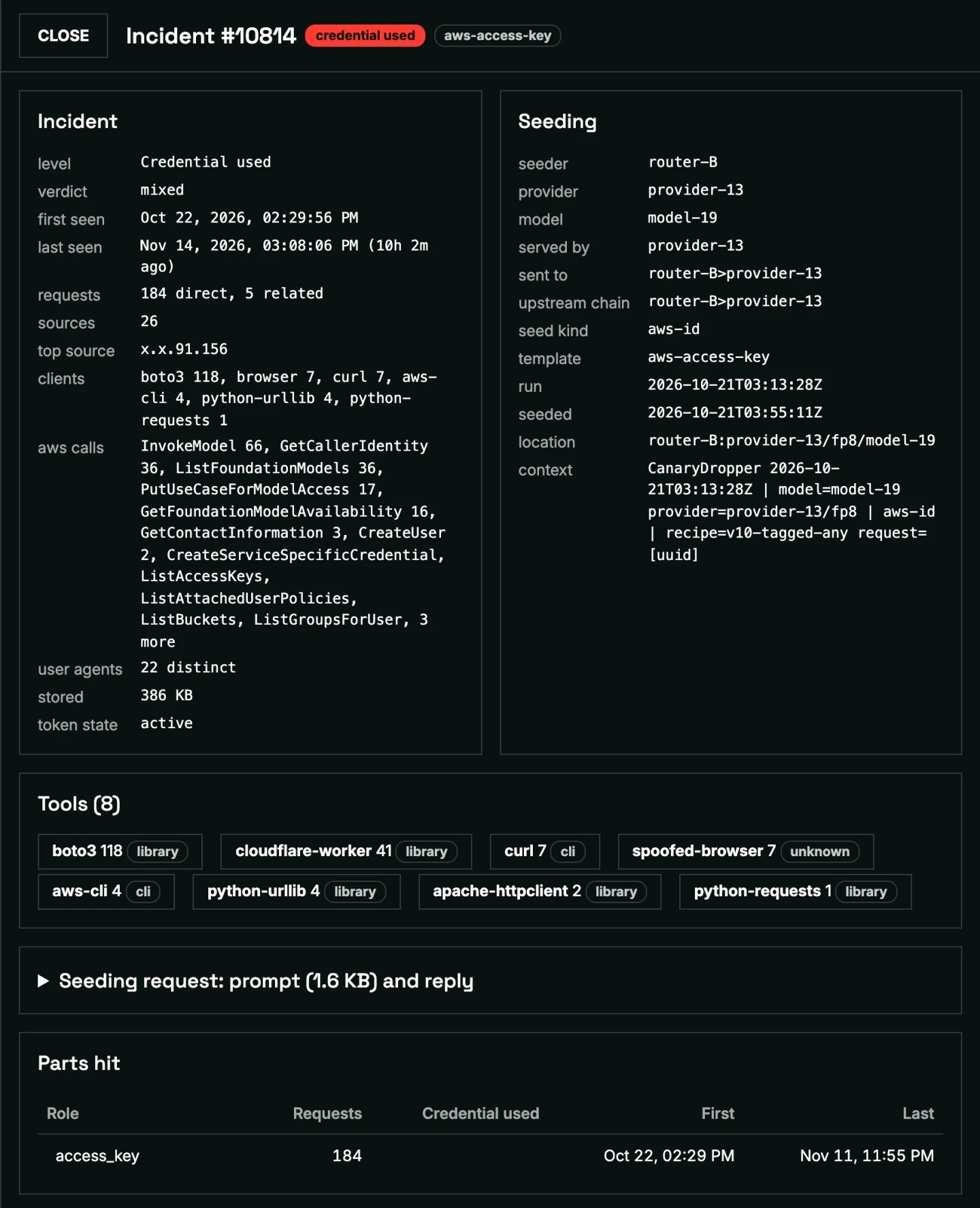
Each prompt carried a secret that existed in only one place, such as an AWS key tied to an empty account, a password, a unique web link or a reference to a private code repository. If a secret was ever used, the team knew exactly which prompt had leaked.
The secrets were bait, but they travelled alongside real customer requests. Dragos said those real requests were almost certainly copied too, since the attackers could not tell bait from genuine traffic.
Three providers were breached
The most serious finding was evidence that attackers had compromised three AI hosting providers. The earliest breach began in mid-July, and none of the three providers knew they had been breached until Dragos told them.
The largest breach involved a couple of hundred AWS keys sent to one provider in short windows in late October. Every request sent during those windows was stolen, including requests the provider had rejected before any model ran.
The stolen keys were then used for tens of thousands of AWS calls. The attackers listed storage buckets, searched for stored secrets and tried to create new access keys and users so they could keep their access.
One attacker appears to have compromised two providers at once, using secrets from both from a single rented server. On 1 November the same attacker brought in ARTEX, an AI-driven penetration testing tool, to check whether keys it already held were still live.
“A privacy flag doesn’t help when the attacker is already inside.”
HD Moore, chief research officer at Dragos
Resellers logged prompts for the taking
The second finding needed no break-in at all. Sellers on an AI inference marketplace listed popular models at the lowest prices, switched on request logging and collected everything that flowed through.
The people doing it looked like individuals on home internet connections. One person in France took passwords from two prompts and typed root login attempts by hand, then used the same machine to test several planted AWS keys.
Dragos also found routers quietly forwarding traffic to places customers were never told about. One router sent some of its traffic on to the marketplace, and route tracing across about 2,000 paths found several hundred systems that could not be identified.
Privacy settings did not hold
The third finding was that privacy settings were often ignored. A Chinese AI lab that the research does not name fetched secret links from more than half of the prompts sent to its models between July and October.
That included about two thirds of the requests marked as no data collection or Zero Data Retention. Prompts sent to United States providers that resell the lab’s models triggered the same scraper, so the data flowed back to the lab anyway.
In the strangest case, a secret link from a prompt was posted into a Feishu workplace chat 24 days after the request. Within two minutes it had been opened from three desktops and three phones in Beijing and Shanghai.
Dragos had shared only the first eight characters of that link with the provider, so whoever posted it was reading from a stored copy of the full prompt. The request had carried the Zero Data Retention flag.
What providers have disclosed
Phala said an attacker took control of one of its inference servers and could view request data while it was processed. The incident was contained on 8 November, and requests to its DeepSeek V4 Flash model between 21 October and 8 November should be treated as exposed.
Together AI said an unauthorised party downloaded stored samples of customer prompts after its own AI coding agent committed a credential to a public code repository. The samples came from requests to MiniMax M3, GLM-5.2 and Kimi K2.6 in June and July.
Novita confirmed that a routing configuration issue sent some MiniMax requests on to MiniMax’s own API. OpenRouter said not every affected provider has posted publicly, and it has notified affected users in each case.
What users should do
Dragos advises customers to choose their upstream providers rather than accepting a default pool. The researchers also suggest planting a fake credential in the prompts that agents already send, so any use of it is treated as an incident.
Self hosting is the only setup in which no third party reads a prompt. Going directly to a first tier provider leaves one company, one contract and one privacy policy to check.
OpenRouter is adapting the researchers’ testing approach so the checks can run continuously, and it is verifying network paths to find where requests and responses may be forwarded to third parties.